Size is one of the first decisions you'll make — and it affects everything downstream: readability from the road, how many you can afford, whether they'll fit most lawns, and whether they'll clear local zoning rules.
The short answer: 18" x 24" (or its landscape equivalent, 24" x 18") is the standard for the vast majority of campaigns. But "standard" doesn't mean it's always the right call. This guide covers every common size, how to choose based on placement and budget, design basics, materials, and the legal rules you need to check before you order.
Key Takeaways
- The de facto standard is 18" x 24" — fits standard wire stakes and stays readable from 40–50 feet with proper text sizing
- 12" x 18" works better for dense neighborhoods or high-quantity grassroots deployments
- 24" x 36" suits roadside placements, but at exactly 6 sq ft it hits many municipal size caps
- Font size and color contrast matter as much as the physical sign dimensions
- Check local zoning rules and HOA policies before ordering; most jurisdictions cap signs at 6 sq ft per face
Standard Campaign Yard Sign Sizes: A Complete Reference
Campaign yard signs follow vendor-established conventions, not any federal or OSHA standard. The 18" x 24" / 24" x 18" format dominates because it fits 4mm corrugated plastic's fluted channels, which accept standard wire H-stakes — a hardware compatibility that has locked in the format as the industry default.
Here's a practical reference for the five main formats:
| Size | Best Use | Readability Planning Note |
|---|---|---|
| 12" x 18" | Dense residential areas, pedestrian zones, high-quantity grassroots | 2"–3" text ≈ 20–30 ft readable distance |
| 18" x 24" / 24" x 18" | All-purpose campaign standard — fits most yards and all H-stakes | 4"–5" text ≈ 40–50 ft readable distance |
| 24" x 36" | Roadside placement, larger lots, lower foot-traffic areas | 5"–7" text ≈ 50–70 ft; equals exactly 6 sq ft (common municipal cap) |
| 12" x 24" rider | Horizontal designs with minimal text or logo-forward layouts | 2"–3" text ≈ 20–30 ft; less common format |
| 6" x 24" rider | Add-on panel for "Vote Tuesday," website URL, or endorsements | Best for 1–3 words only; attaches to a primary sign |
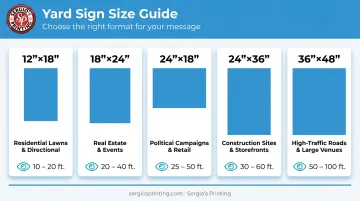
Readability estimates use the United States Sign Council Foundation's conservative 10 ft per inch parallel-sign guideline — a useful planning rule for yard signs viewed at shallow angles.
Portrait vs. Landscape: 18x24 or 24x18?
Same sign area, different orientation. Portrait (18" wide x 24" tall) is more common for candidate name-recognition signs — the taller format naturally stacks the candidate name above the office title. Landscape (24" wide x 18" tall) suits horizontal layouts or campaigns that want a wider visual footprint at eye level.
Sergio's Printing stocks both the 24" x 18" landscape standard and the 24" x 36" roadside format, with custom sizing available for non-standard dimensions.
How to Choose the Right Campaign Yard Sign Size
The Viewing Distance Principle
Start with where the sign will actually live. A front-yard sign 8 feet from the sidewalk has completely different requirements than one staked along a 45-mph county road. The math is straightforward: readable distance ≈ letter height in inches × 10 feet.
So a sign with a 4-inch candidate name is readable from roughly 40 feet. A 5-inch name pushes that to 50 feet. If your sign is going roadside and drivers are passing at speed, you need larger text — which usually means a larger sign to fit it.
Placement Context and Density
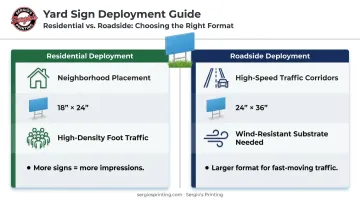
Two distinct placement strategies exist, and they call for different sizes:
Residential yard placements:
- Portrait orientation works well for name recognition
- 18" x 24" fits most lawns without crowding
- Smaller 12" x 18" signs let you place more in denser neighborhoods
- 100 smaller signs often generate more total impressions than 30 large ones in walkable areas
Roadside placements:
- Landscape orientation and larger formats improve visibility for fast-moving traffic
- 24" x 36" is appropriate but verify it doesn't trigger local size caps
- Heavier-gauge or double-foot stakes are worth using in wind-exposed locations
Once you know where signs are going, the type of race shapes which size to prioritize.
Campaign Type and Scale
Local elections — school board, city council, county commission — typically do well with 18" x 24" signs for neighborhood deployment. Local elections — school board, city council, county commission — typically do well with 18" x 24" signs for neighborhood deployment. Research from Yale's Institution for Social and Policy Studies found yard signs can produce a roughly 1.7 percentage-point increase in candidate vote share across four randomized field experiments, driven by name recognition and repeated visibility rather than turnout.
Consistent, well-placed signs on high-traffic voter routes outperform a handful of oversized formats. Prioritize coverage over size for residential campaigns.
Larger district or statewide campaigns often mix sizes — 18" x 24" for residential density, 24" x 36" for arterial roads — while keeping a consistent color scheme across the fleet to build recognition.
Budget Considerations
Larger signs cost more per unit and more to ship. A few practical rules:
- Bulk orders reduce per-unit cost at any size — run the math on your total quantity before committing
- If budget is tight, more 18" x 24" signs usually outperform fewer 24" x 36" signs for residential campaigns
- Factor in stake costs — H-stakes are typically sold separately and add up across large orders
Design Tips to Maximize Your Campaign Sign's Impact
A correctly sized sign with an unreadable design is money wasted. Keep the design to a single glance: candidate name, office sought, nothing else.
Font Selection and Text Size
The clearest guidance from signage research: use simple, high-contrast, non-decorative lettering. Sans-serif fonts like Arial, Helvetica, or Franklin Gothic hold up best at distance.
Key rules for the standard 18" × 24" sign:
- On an 18" x 24" sign, candidate name text should be at least 4–5 inches tall for meaningful roadside readability
- Limit the sign to: name + office sought, and optionally a party affiliation or short phrase
- Every additional line of text reduces the size of every other line — less text usually means a more readable sign
Color Contrast and Psychology
USSCF research on sign legibility found that positive-contrast signs — light text on dark backgrounds — outperform reversed contrast for recognition, particularly in low-light conditions.
For campaign signs specifically:
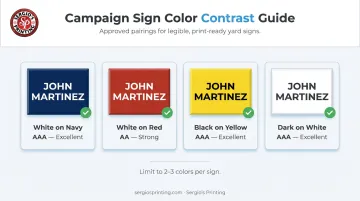
- High-contrast combinations that work: dark navy on white, white on red, black on yellow
- Limit to two or three colors: one dominant background, one high-contrast text color, one optional accent
- Red/blue/yellow carry partisan associations in U.S. political contexts — use them for brand consistency and contrast, not as psychological shortcuts
- Consistent color scheme across all signage reinforces name recognition district-wide
Material and Display Hardware for Campaign Yard Signs
Corrugated Plastic (Coroplast)
Nearly every campaign yard sign is printed on corrugated plastic — lightweight, weather-resistant, UV-stable, and compatible with wire stakes. Sergio's Printing uses 3mm white Coroplast for their yard signs, which is slightly thinner than the 4mm standard cited by some vendors but shares the same fluted construction that accepts H-stakes.
Key material facts:
- Handles rain, sun, and wind across a typical campaign season
- Full-color printing available single-sided (4/0) or double-sided (4/4)
- Standard 24" x 18" and 24" x 36" available directly; custom sizes via quote
Stakes and Mounting Options
Wire H-stakes are the standard hardware. They slide into the corrugated channels and push into the ground. At Sergio's Printing, H-stakes are sold separately and can be added during checkout.
For signs in wind-exposed locations or heavier 24" x 36" formats, heavier-gauge stakes provide better hold. For fence, post, or wall mounting, Sergio's Printing offers grommets as an add-on, available in two-grommet (top) or four-grommet (all corners) configurations.
Single-sided vs. double-sided printing:
- Double-sided (4/4): Recommended for any freestanding sign — people and vehicles approach from both directions, and a blank back loses half your impressions
- Single-sided (4/0): Practical only for wall, fence, or window mounting where one face stays hidden
Local Regulations and Placement Rules
Most U.S. municipalities regulate yard sign placement through local zoning ordinances. A 6 sq ft per face cap appears frequently — a 24" x 36" sign equals exactly 6 sq ft, while an 18" x 24" sign is only 3 sq ft, so size choice directly determines compliance.
A few documented examples:
- Westlake Village, CA: Election signs capped at 6 sq ft per face, 5 ft height, private property only; allowed starting 35 days before ballot submission deadline and must be removed 2 days after the election
- Walton Hills, OH: Political signs capped at 6 sq ft, 4 ft height, max eight signs per lot; must be removed within 15 days after the election
- Cortland, OH: No individual sign face may exceed 6 sq ft, with a 12 sq ft total area limit per property
Height limits typically run 3–5 feet including the stake. HOA rules add another layer of complexity — some states, including Arizona and California, have statutes limiting HOA authority over political signage, but those protections don't override local size and placement rules.
Before ordering, check with: your local city or county planning department, your local election board, and any applicable HOA governing documents. Don't assume any size is automatically compliant.
Frequently Asked Questions
What is the most popular size for a campaign yard sign?
18" x 24" (portrait) or 24" x 18" (landscape) is the most widely used size in U.S. campaigns. It balances visibility from roughly 40–50 feet with a footprint small enough for most residential yards and full compatibility with standard wire H-stakes.
What is the difference between an 18x24 and a 24x18 yard sign?
These are the same sign area in different orientations. 18x24 is portrait (taller than wide), which works well for candidate name-recognition signs. 24x18 is landscape (wider than tall), which suits horizontal designs or real estate layouts. The choice is about design, not size.
How far away can a campaign yard sign be read?
Use this planning formula: readable distance ≈ letter height in inches × 10 feet. A standard 18" x 24" sign with 5-inch candidate name text is readable from approximately 50 feet. Larger signs with bigger text extend that range. Cramped text on any sign size reduces it.
Are there legal restrictions on campaign yard sign sizes?
Yes. Most municipalities regulate sign area and height through zoning codes. A 6 sq ft per-face cap and 3–5 ft height limit (including stake) are common benchmarks. Verify your specific local ordinances, county rules, and any HOA restrictions before ordering.
Can campaign yard signs be printed on both sides?
Yes, and double-sided printing is recommended for any freestanding sign. Signs viewed from both directions of foot and vehicle traffic double their potential impressions. Single-sided printing is only practical for signs mounted flat against a wall, fence, or in a window.
What material are campaign yard signs typically made from?
The standard is corrugated plastic (Coroplast): lightweight, weatherproof, UV-resistant, and designed to accept wire H-stakes in its fluted channels. Sergio's Printing prints on white Coroplast with full-color options available on one or both sides.