Introduction
Bigger isn't always better when it comes to real estate signs. The agent who orders the largest available panel for a quiet residential street wastes money and risks HOA violations. The one who defaults to the smallest size on a busy commuter corridor loses leads before drivers even register the listing.
Sign size controls three practical outcomes: whether someone notices the sign, whether they can read it before they've passed it, and whether the sign stays within local regulations. Miss any one of those, and the sign fails no matter how well-designed it is.
This guide covers every standard real estate sign dimension, what each size is built for, and the decision framework agents use to choose the right one for each listing.
Key Takeaways
- 18" x 24" is the standard residential yard sign — works on most neighborhood streets and fits virtually all frames
- 24" x 36" is the step-up size for busier roads, large-frontage lots, or properties set far back from the street
- Riders (6" x 24" or 8" x 24") attach above or below the main panel for "Open House," "Sold," or agent contact info
- Commercial signs run 48" x 48" to 48" x 96" on heavy-duty substrates
- Most US municipalities cap residential sign area at 6 square feet — always check local ordinances before you order
Standard Real Estate Sign Sizes: A Quick-Reference Guide
Real estate signage covers several distinct product categories, and print vendors build their hardware, frames, and template libraries around specific standard dimensions. Knowing which sizes belong to which category saves ordering mistakes.
For Sale / Main Yard Sign Panels
Three panel sizes cover the vast majority of residential listings:
| Size | Dimensions | Face Area | Typical Use |
|---|---|---|---|
| 18" x 24" | 1.5 ft × 2 ft | 3 sq ft | Standard residential — the default choice |
| 24" x 30" | 2 ft × 2.5 ft | 5 sq ft | Higher-traffic roads, wider frontage |
| 24" x 36" | 2 ft × 3 ft | 6 sq ft | Premium listings, large lots, long setbacks |
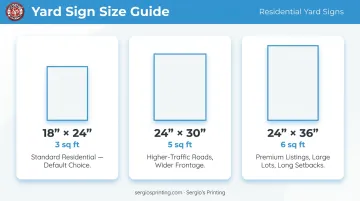
The 18" x 24" panel is the industry baseline, confirmed by multiple print vendors including UPrinting, PrintPlace, and PrintRunner. The 24" x 36" hits the 6 sq ft threshold that many US municipalities cap as the maximum for temporary residential signs — more on that in the regulations section.
Orientation matters too. Horizontal (landscape) layouts suit most standard H-frame hardware. Vertical (portrait) layouts — a 24" x 36" turned to 36" x 24" — are increasingly popular on luxury listings for a more contemporary look. Check frame slot dimensions before committing to portrait orientation.
Sergio's Printing produces both 24" x 18" and 24" x 36" as standard yard sign sizes, printed on 3mm white Coroplast with full-color printing available on one or both sides. Custom dimensions are available through their online platform.
Sign Riders
Riders are narrow supplemental panels that mount above or below the main sign. They communicate status or event updates without requiring a full panel replacement.
Standard rider dimensions:
- 6" x 24" — most common residential rider size
- 8" x 24" — slightly taller, better readability from distance
- 6" x 18" — compact option for smaller frames
Common rider messages include "Open House," "Sold," "Pending," agent phone numbers, and website URLs. Sergio's Printing can produce custom-dimensioned riders through their yard sign custom-size ordering option.
Directional and A-Frame Signs
A-frames and directional arrows are temporary, portable, and typically made from lightweight coroplast for easy transport and setup.
- A-frame panels: 18" x 24" and 24" x 24" are most common; 24" x 36" for higher-visibility intersections
- Directional arrow signs: Usually 18" x 24" or 24" x 18"
Sergio's Printing offers A-frame signs in 24" x 36" on 3mm white Coroplast, with single or double-sided printing and a white Signicade Deluxe plastic frame included.
Commercial Real Estate Signs
Commercial listings operate at a different scale. Standard commercial sign sizes run from 48" x 48" (4' x 4') up to 48" x 96" (4' x 8'), with the larger format common in industrial and retail corridors.
These signs are built for months of continuous outdoor exposure rather than the weeks typical of residential listings. Common substrates include:
- Aluminum composite — lightweight, weather-resistant, industry standard
- Crezon board — rigid, paintable, handles heavy outdoor use
- Heavy PVC — cost-effective for medium-duration installations
Sergio's Printing offers aluminum signs in 0.040 and 0.060 thickness through their large format category — both gauges are well-suited for real estate and property marketing applications.
How Sign Size Affects Visibility and Readability
Sign size and readability are related, but they don't move in lockstep. A larger panel only improves performance if the design uses that space to increase text size — not to add more content.
The Letter Height and Viewing Distance Relationship
The International Sign Association states that letters should be at least 1" tall for every 25 feet of required viewing distance. The USSC Best Practice Standards support a similar approach, using a Legibility Index of 30 for perpendicular signs — meaning 1" of letter height per 30 feet of viewing distance.
In practical terms for residential real estate:
- A phone number that needs to be readable from 60 feet requires letters at least 2" tall
- A street address readable from 90 feet needs letters at least 3" tall
- A larger panel gives you room for larger text — which is the actual point of sizing up
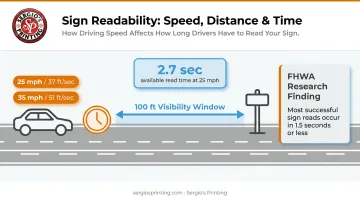
At 25 mph, a driver covers roughly 37 feet per second. At 35 mph, that jumps to about 51 feet per second. A sign visible from 100 feet gives a 25 mph driver approximately 2.7 seconds to read it — and FHWA research on sign glance behavior indicates most successful sign reads occur in glances of 1.5 seconds or less. That's a tight window with very little margin for small text.
Sign Size and Layout Density
The most common mistake agents make is ordering a larger panel, then filling it with more information — more phone numbers, a website, a QR code, a tagline, a headshot. The result is a sign that's harder to read than the smaller one it replaced.
The correct use of additional space is larger text and fewer elements, not more elements at the same size.
An 18" x 24" with three elements — headline, name, phone number — will outperform a 24" x 36" with six lines of cramped content. The math doesn't change regardless of panel size.
Color contrast affects legibility just as much as text size. The USSC Foundation's color and illumination research found that positive-contrast signs (dark text on light background) consistently outperform negative-contrast equivalents for both recognition and legibility. For real estate signs: black or dark navy text on white or light backgrounds reads better than white text on dark backgrounds, especially at distance.
Placement as a Size Multiplier
Physical placement affects perceived size more than most agents realize. A correctly-sized sign:
- Mounted above the shrub line
- Perpendicular to traffic flow (not angled)
- Free of obstructions within the driver's sightline
...will outperform a larger sign half-hidden behind landscaping or mounted at ground level. Post height matters. Sign angle matters. Before sizing up to a larger panel, check placement first — it's the cheaper fix and often the more effective one.
Choosing the Right Real Estate Sign Size for Your Listing
Size selection works best as a four-variable decision: the physical setting, the viewing audience, the property type, and any applicable size restrictions.
Traffic Speed and Road Type
This is the primary driver of size selection:
- 25 mph residential street: 18" x 24" is sufficient for most placements
- 35–40 mph collector road or corner lot: 24" x 30" or 24" x 36" with a simplified layout
- 45+ mph arterial road: Maximum allowed size, with large text and minimal design elements
Cul-de-sac placements and corner lots on commuter streets look similar on paper but perform very differently. The corner lot sign must grab attention from two directions at higher speeds, competing with intersection visual noise — which is why size and layout both matter there.
Property Setback from the Street
When a property sits well back from the curb — long driveways, deep lots, significant landscaping between the sign and passing traffic — the effective viewing distance increases even though the sign hasn't moved.
If the sign must be placed more than 30–40 feet from where viewers pass, move up one size tier. A sign that works at 18" x 24" for a street-adjacent placement needs 24" x 36" when the same viewer is reading it from twice the distance.
Residential vs. Luxury vs. Commercial
| Property Type | Recommended Size | Notes |
|---|---|---|
| Standard residential | 18" x 24" | Works on most streets, universally frame-compatible |
| Premium / luxury residential | 24" x 36" | More commanding presence; pair with restrained design |
| Commercial | 48" x 48" to 48" x 96" | Heavy-duty substrate required for extended exposure |
For luxury listings, material quality often matters as much as size. An 18" x 24" printed on a quality substrate with a clean, high-contrast design reads as more premium than a 24" x 36" on standard coroplast with a cluttered layout. If you're printing signs for higher-end listings, Sergio's Printing offers multiple substrate options — including heavier-duty materials — that help the finished sign match the property's positioning.
Sign Size Regulations and HOA Rules You Need to Know
Sign size isn't purely a design decision. In most US municipalities, real estate signs are classified as temporary signs and fall under local zoning ordinances that regulate maximum face area, height, placement, and display duration.
The common threshold is 6 square feet — but it's not universal, and "common" doesn't mean safe to assume.
Real examples from verified municipal codes:
- [Verify City Name], FL: Real estate signs capped at 6 sq ft total surface area, maximum 5 ft height
- Plain City, OH: Residential real estate signs limited to 6 sq ft and 4 ft height, one sign per street frontage
- Binghamton, NY: Residential lots capped at 4 sq ft per sign — meaning even an 18" x 24" panel (1.5 sq ft) is fine, but a 24" x 36" (6 sq ft) would exceed it
- Miami-Dade County, FL: Residential real estate signs limited to 4 sq ft; the 6 sq ft threshold applies as a permit-exemption limit, not a size cap
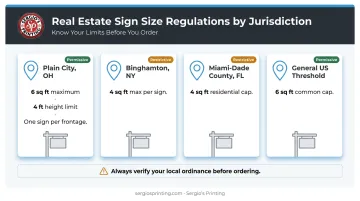
That last point matters for agents working in South Florida. A 24" x 36" panel at 6 sq ft technically exceeds the 4 sq ft residential cap in Miami-Dade — even though it would be compliant in many other jurisdictions.
HOA Rules Add Another Layer
Homeowners associations can impose restrictions stricter than local zoning, sometimes limiting sign type, placement zone (front yard only, no post signs, etc.), and display duration.
State law determines how much power HOAs actually have over sign restrictions:
- California (Civil Code §§ 712–713): HOA provisions that prohibit or unreasonably restrict for-sale signs — when reasonably located and of reasonable dimensions — are void. Owners have explicit statutory protection.
- Florida: No equivalent statute exists. HOA sign restrictions are generally enforceable, making it especially important for South Florida agents to review governing documents before installing any sign.
The enforceability of HOA sign rules varies significantly by state, which means compliance isn't just a local zoning question.
Before ordering any panel larger than 18" x 24": check the local zoning ordinance and any applicable HOA rules. This takes 15 minutes and prevents compliance problems after the sign is already printed.
Common Real Estate Sign Sizing Mistakes to Avoid
Three mistakes account for most real estate sign problems in the field:
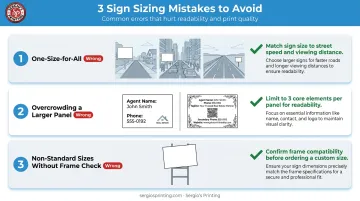
Defaulting to one size regardless of context. Agents who always order 18" x 24" miss impact at high-traffic listings. Agents who always order the largest panel create compliance issues and look out of place on smaller residential lots. Match the size to the specific environment.
Treating a larger panel as an invitation to add more information. A 24" x 36" is not the place to add a second phone number, a website URL, a QR code, and a tagline. The extra space is for larger, bolder versions of your three essential elements. More size should mean more impact per element — not more elements.
Ordering non-standard sizes without confirming frame compatibility. Standard H-frame hardware is built around specific panel dimensions, primarily 18" x 24" and 24" x 36". A panel that doesn't fit existing frame slots creates installation problems in the field. Confirm hardware slot dimensions before ordering. If you need a custom size, contact Sergio's Printing directly at (305) 971-4161 to discuss H-stake and mounting options before finalizing your order.
Frequently Asked Questions
What size are most real estate signs?
The 18" x 24" panel is the most widely used size for residential yard signs, balancing visibility, portability, and frame compatibility. For higher-traffic settings or larger properties, agents step up to 24" x 30" or 24" x 36".
How big is an 18x24 yard sign?
An 18" x 24" sign measures 1.5 feet tall by 2 feet wide, giving you 1.5 square feet of face area. It's readable from approximately 60–70 feet and fits most standard real estate H-frames and post systems without modification.
What size are real estate sign riders?
Riders are typically 6" x 24" or 8" x 24" and attach above or below the main sign panel. They display supplemental messages like "Open House," "Sold," "Pending," or a second contact number.
What is the maximum size allowed for a real estate sign?
Many US municipalities cap temporary residential signs at 6 square feet (equivalent to a 24" x 36" panel), but limits vary. Miami-Dade caps residential real estate signs at 4 sq ft. Always verify local zoning ordinances and HOA rules before ordering a larger panel.
What size are commercial real estate signs?
Commercial real estate signs commonly range from 48" x 48" to 48" x 96", printed on heavy-duty substrates like aluminum composite or thick PVC to withstand extended outdoor exposure in high-traffic commercial environments.
Can I order a custom size for my real estate sign?
Yes. Sergio's Printing offers custom-size yard signs through our online platform, where you can specify exact width and height dimensions. Non-standard sizes may not fit off-the-shelf frames, so confirm mounting hardware compatibility before placing a custom order.