Introduction
Digital ads disappear in seconds. A well-designed postcard sits on the kitchen counter for days.
That's the core advantage of real estate direct mail — it's physical, it's personal, and it reaches homeowners where they actually live. While social media algorithms shift and email response rates sit at just 0.12%, direct mail averages a 4.4% response rate, according to Keypoint Intelligence. While social media algorithms shift and email response rates sit at just 0.12%, direct mail averages a 4.4% response rate, according to Keypoint Intelligence.
This guide is written for real estate agents, brokers, and investors who want to build or sharpen a direct mail strategy. It covers what direct mail is, why it works, how to run a campaign from list to delivery, and the common mistakes that derail results before they start.
Key Takeaways
- Direct mail averages a 4.4% response rate vs. 0.12% for email — more than 36× higher for lead generation
- Physical mail earns more trust than digital ads: 82% of consumers trust print advertising, vs. 61% for search ads
- Every winning campaign shares four traits: a targeted list, one clear CTA, quality print materials, and consistent send cadence
- Results compound after 4–5 touches — one send proves nothing
What Is Real Estate Direct Mail?
Real estate direct mail is a marketing method where printed materials — postcards, letters, brochures, or newsletters — are sent to a defined list of homeowners or property owners. The goal is to generate seller leads, build name recognition in a farm area, or prompt a conversation about buying or selling.
Unlike brand advertising, direct mail is response-driven. Every piece has a specific action it's asking the recipient to take: call a number, scan a QR code, visit a landing page.
Types of Real Estate Mailers
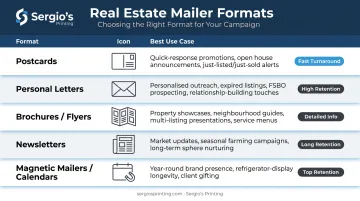
| Format | Best Use Case |
|---|---|
| Postcards | Just Listed/Sold announcements, open houses, market updates |
| Personal & yellow letters | Motivated seller outreach — absentee owners, pre-foreclosures, probate |
| Brochures & flyers | Listing showcases, introducing services to a new farm area |
| Newsletters & market reports | Monthly relationship-nurturing to sphere of influence and farm areas |
| Magnetic mailers & calendars | Long-retention brand exposure — stays visible for months from a single send |
Each format fits a different stage of the relationship. Postcards are fast and visual. Letters feel personal — a handwritten envelope gets opened. Calendars stay on the fridge for months. Choosing the wrong format for your audience wastes budget and kills the message before it's even read.
Why Direct Mail Works in Real Estate
Physical Mail Outperforms Digital on Attention
The response rate gap between direct mail and email — 4.4% vs. 0.12% — reflects a deeper behavioral difference. Physical mail requires a decision: keep it or throw it away. That moment of attention doesn't exist with a digital ad that scrolls past in under a second.
A Canada Post neuromarketing study found direct mail generated 70% higher brand recall and required 21% less cognitive effort than digital advertising. For a high-consideration purchase like a home sale, that recall advantage translates directly to listing inquiries.
The Trust Factor
Consumers rate printed advertising as significantly more credible than digital formats. According to a MarketingSherpa consumer survey, 82% of U.S. consumers trusted print advertising, compared to 61% for search engine ads and just 25% for online pop-ups.
In real estate — where a homeowner is deciding whether to trust an agent with their largest financial asset — trust is the deciding factor. A well-printed, professionally designed mailer signals competence before a single word is read.
The Compounding Effect
Direct mail isn't a single-touch tool. USPS Household Diary data shows the difference between mailing existing customers versus cold prospects:
- Existing customers: 59% reading rate, 16% intended response rate
- Cold prospects: 23% reading rate, 2% intended response rate
That gap narrows as agents build familiarity through repeated sends to the same farm area.
Agents who mail consistently to a defined geographic area become the name homeowners recognize when they're finally ready to sell. One send is a coin flip. Five sends over six months is a relationship.
How to Build a High-Impact Direct Mail Campaign
A high-performing campaign follows five sequential steps. Each one builds on the last — cut one and you cut your response rate.
Step 1: Define Your Target List
List quality drives results more than any other variable. A refined list of motivated prospects will consistently outperform a broad zip-code blast.
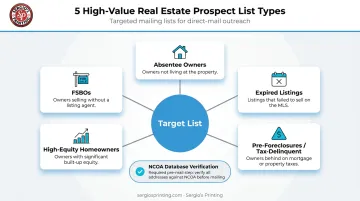
High-value real estate prospect lists include:
- Absentee owners : properties where the mailing address differs from the property address
- Expired listings : homeowners who tried to sell and failed
- Pre-foreclosures and tax-delinquent owners : time-pressured sellers
- High-equity homeowners : likely candidates for a move-up or downsizing conversation
- FSBOs : sellers already in motion but without representation
Agents build these lists through public records, county databases, MLS tools, or list brokers. Before mailing, run every list against the NCOA (National Change of Address) database — NCOALink holds approximately 160 million permanent change-of-address records. Mailing to outdated addresses wastes postage and inflates your apparent non-response rate.
Step 2: Select the Right Mailer Format
Match the format to both your audience and your goal:
| Audience | Best Format |
|---|---|
| Luxury homeowner outreach | Premium letter on heavy stock with quality finishes |
| Absentee owner campaign | Simple, direct postcard with a clear value proposition |
| Farm area brand-building | Newsletter or calendar for long-term visibility |
| Open house announcement | Postcard for quick turnaround and visual impact |
Using a calendar-style mailer for a motivated seller campaign wastes money. Using a cheap postcard for a $2M+ luxury target undermines your positioning before the call is made.
Step 3: Write a Message That Gets a Response
Every real estate mailer has one job: get the homeowner to take one specific action.
Effective direct mail copy:
- Leads with the homeowner's name and something hyper-local (their street, a recent sale price nearby)
- Hooks with relevance — "Your neighbor at [address] just sold for $X — here's what your home could sell for now"
- Includes a single clear CTA (call this number, scan this code, visit this URL)
- Focuses on the homeowner's situation, not the agent's credentials
The most common copy mistake is writing about the agent — years of experience, awards, number of transactions. Homeowners don't care about your resume until they care about selling. Lead with what they get, not who you are.
Step 4: Execute with Professional Print Quality
Print quality is a proxy for competence. A flimsy, poorly printed postcard signals an agent who cuts corners — not someone a homeowner trusts with their home.
Design essentials for real estate mailers:
- High-resolution property images (300 dpi minimum for print)
- Clear visual hierarchy — headline, supporting info, CTA, contact
- Brand-consistent colors and typography throughout
- Appropriate paper weight — 14 pt card stock is standard for postcards
Finish choices matter in-hand. UV coating adds shine and durability. Heavier stock feels more substantial. These details are noticed, even when recipients can't articulate why one piece felt more credible than another.
Most agents see meaningful results after 4–5 touches. Mail monthly or every 6–8 weeks — consistency matters more than volume.
Tracking options:
- QR codes linked to home valuation landing pages
- Unique phone numbers per campaign (tracks inbound calls to specific mailers)
- Personalized URLs (PURLs) — unique web addresses per recipient
When to stop mailing a contact:
- The property sells
- The owner requests removal
- You've acquired the listing
Pull non-responders after 8–10 touches with no engagement. Redirect that budget toward fresh, higher-probability prospects.
Best Practices for Real Estate Direct Mail
Consistency Beats Volume
One send of 2,000 postcards is less effective than 400 postcards mailed monthly for six months to the same list. Repetition builds familiarity, and familiarity drives the call when the homeowner is finally ready.
A practical starting framework:
- Sphere of influence: Monthly newsletter or market update, 50–200 contacts
- Geographic farm area: Monthly or bi-monthly postcard, 300–500 homes minimum
- Targeted prospect list: Monthly personalized letter or postcard, 100–300 names
Personalization at Scale
Variable data printing (VDP) lets agents customize each piece — recipient name, property address, neighborhood comparable sales — across large print runs without manual effort. According to Keypoint Intelligence's 2024 consumer survey, roughly two-thirds of consumers pay closer attention to personalized direct mail than generic pieces. Nearly 60% are more likely to notice mail when the offer is relevant to their personal situation.
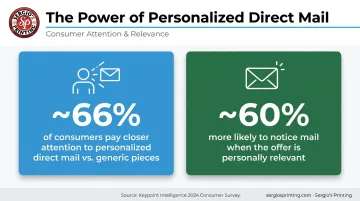
Those numbers reflect a real behavioral shift. Personalization is what makes mass mail register as relevant to the individual receiving it.
Use a Single, Clear CTA
Every mailer must direct the recipient to exactly one next step. Multiple CTAs split attention and reduce action.
Effective CTAs by campaign type:
- "Find out what your home is worth — scan here" (seller lead generation)
- "Join us Saturday 1–4PM — RSVP at [URL]" (open house)
- "See what homes are selling for in [neighborhood] — call [number]" (market update)
Pair Direct Mail with Digital
Key findings on integrated campaigns:
- Canada Post research found integrated direct mail and digital campaigns received 39% more attention than single-media digital campaigns
- USPS Informed Delivery — which emails homeowners a daily preview of incoming mail — carries a 60.1% daily digest open rate as of Q2 FY2025
- Two brands in USPS case studies boosted response rates by more than 30% by combining Informed Delivery previews with physical mailers
The practical version for agents: run a matching Facebook or Google retargeting ad to the same geographic audience during your mailing window. When the homeowner sees your postcard in the mailbox and your ad on their phone the same week, recognition builds across both touchpoints.
Common Direct Mail Mistakes to Avoid
Don't quit after one send. One mailing with a low response rate proves nothing — the response curve builds across multiple touches. Most campaigns need 4–5 sends before the data means anything.
Generic lists waste budget. Mailing an entire zip code with a one-size-fits-all message thins out both spend and impact. Narrowing to high-probability audiences — absentee owners, high-equity areas, neighborhoods with 5%+ annual turnover — pulls response rates up.
Clarity beats design complexity every time. Crowding a piece with images, color blocks, and credential listings at the expense of a clear message is a common failure point. Recipients decide whether to keep or toss in under three seconds, and a cluttered layout loses every time.
Frequently Asked Questions
What is the average ROI for real estate direct mail?
Cross-industry benchmarks from ANA's 2023 Response Rate Report show direct mail ROI of 160.9% for house/customer files and 33.7% for cold prospect files. No verified real estate-specific ROI benchmark exists, but direct mail generally outperforms most digital channels when list quality and campaign consistency are high.
How expensive is real estate direct mail marketing?
USPS postage for EDDM runs as low as $0.242–$0.247 per piece, making it one of the most cost-effective options for neighborhood saturation. Postcard printing typically runs $0.32–$0.45 per piece at standard quantities, with bulk orders reducing that further. First-Class Mail postage runs $0.61 per piece — higher cost, but it delivers faster and qualifies for mail forwarding.
Is real estate direct mail effective?
Yes, when done consistently and with proper targeting. Direct mail earns higher trust than digital formats, reaches demographics less active on social platforms, and produces measurable response rates that outpace email. Sporadic, generic campaigns underperform. Targeted campaigns sent repeatedly to the same list compound in effectiveness over time.
How often should real estate agents send direct mailers?
Monthly or every 6–8 weeks is the recommended cadence. Results typically compound after 4–5 touches with the same list. Agents who mail once and pause lose the momentum built from repeated exposure.
What should you include on a real estate direct mail piece?
The recipient's name, a hyper-local hook (recent neighborhood sale prices or a home value offer), a single clear CTA, and the agent's contact information or QR code. Keep it focused — one message, one action, one outcome.
What is Every Door Direct Mail (EDDM) and how does it work for real estate?
EDDM is a USPS service that delivers mailers to every address on a defined carrier route without requiring an address list. At $0.242–$0.247 per piece, it's cost-effective for brand-building in a new farm area, though it can't target individual recipients the way addressed mail can.