The real question isn't whether business cards still matter. It's whether yours is doing any actual work. A generic, template-free card can make you forgettable. A card designed to reflect your brand, industry, and professionalism can open conversations and keep your business in someone's wallet for months.
This article covers the practical, real-world advantages custom business cards deliver for entrepreneurs — from the credibility they build on first contact to the passive marketing they provide long after the conversation ends.
Key Takeaways
- Custom business cards create a tangible first impression that no digital contact exchange can replicate
- A card that reflects your brand signals credibility before you speak — critical for solo founders and new businesses
- Physical cards keep working passively, resurfacing when someone needs your service weeks or months later
- Generic or mismatched cards create a brand consistency gap that erodes trust at key networking moments
- At roughly $0.03 per card when ordered in bulk, business cards are one of the lowest-cost marketing tools available to small businesses
What Are Custom Business Cards?
A custom business card is designed specifically to reflect your brand identity — your colors, fonts, logo, tagline, paper weight, and finish — rather than copied from a generic print-on-demand template.
"Custom" covers two layers:
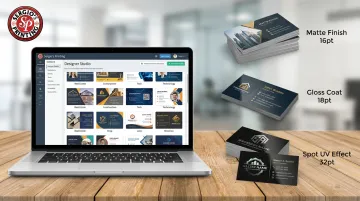
- Design choices: layout, finish (matte, gloss, spot UV), paper weight, corner style
- Content choices: what information to include, what tone to project, what the card communicates before anyone reads it
That second layer is what most entrepreneurs underestimate. The visual design communicates brand values the moment the card is touched. The words on it confirm those values — and when both are intentional, the card does selling work before you say a word.
Key Benefits of Custom Business Cards for Entrepreneurs
The benefits below aren't theoretical. They affect outcomes entrepreneurs actually care about: first impressions, referrals, brand recall, and return on a small upfront investment.
Brand Identity That Works Before You Speak
A custom business card is a physical extension of your brand. Before a prospect reads your name or title, they've already formed an impression from the card's weight, finish, color palette, and overall design quality.
Research from Willis and Todorov's peer-reviewed study found that trait judgments — including trustworthiness and competence — formed after just 100 milliseconds of exposure correlated strongly with judgments made without any time constraint. Your card arrives in someone's hand before you've finished your introduction.
A Stanford/Consumer WebWatch study of 2,684 participants found that visual design was the most frequently cited credibility factor, appearing in 46.1% of credibility comments. While that study examined websites, the underlying principle holds across physical materials: design quality signals professionalism before content does.
For entrepreneurs specifically:
- New and solo founders can't rely on brand recognition the way established companies can — a well-crafted card does credibility work the moment it changes hands
- Industry-appropriate design signals competence to the right audience; a food-service card should feel different from a corporate consulting card
- Sergio's Printing offers templates across multiple industry categories — from Beauty & Spa to Food & Beverage to Creative — making it practical to design a card that fits your niche even without a dedicated design budget
Highest impact: When entering a competitive local market, attending trade shows, or when your personal brand directly drives revenue.
Networking Memorability and Conversation Value
Handing someone a physical card is a deliberate, personal act. Tapping phones or sharing a LinkedIn profile gets the job done, but it doesn't create the same moment.
A card with an unexpected finish, a bold color choice, or a distinctive layout becomes a conversation piece at the exchange — and stays in someone's memory well beyond it. Touch matters here. Research by Peck and Shu found that physically handling an object increases perceived ownership and evaluation, suggesting that the tactile experience of a quality card contributes to how positively someone responds to it.
More practically: a card sitting on someone's desk or in their wallet reappears organically when they encounter someone who needs exactly what you do. That's passive referral generation that requires no further effort from you.
Why this matters most for entrepreneurs:
- Unlike a LinkedIn notification, a physical card resurfaces without any action on your part
- In high-volume networking scenarios — trade shows, chamber events, industry conferences — design quality is what separates the cards that get kept from the ones that get cleared out
- A card on a desk is a referral prompt; a forgotten digital contact is not
Highest impact: Any environment where you meet many people quickly and need to stand out from a crowded field of contacts.
A Low-Cost Marketing Tool That Keeps Working
Custom business cards are inexpensive to produce and have no ongoing cost once printed. IBISWorld's 2026 benchmark puts the market price at $15.40 per 100 business cards. At Sergio's Printing, 1,000 cards start at $28.88 — roughly $0.03 per card — with tiered pricing at 500, 5,000, and 10,000 units that brings the per-unit cost down further.
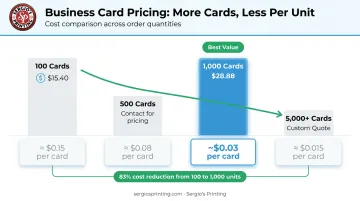
That per-card cost covers every impression the card generates: in a wallet, on a desk, passed from one contact to another. A paid ad stops delivering the moment your budget pauses. A card handed out today might resurface six months from now at exactly the moment someone needs your service.
Ways to extend a card's marketing value:
- Use the back for a QR code linking to your portfolio or booking page
- Add a tagline that clarifies what you actually do
- Include a specific service or offer that gives people a reason to reach out
- Leave a small stack at relevant local businesses — coffee shops, partner services, gyms — to extend reach without any additional spend
Ordering 1,000 cards instead of 100 cuts the per-unit cost by roughly 83%. That difference matters: bulk pricing lets you distribute freely and network confidently, rather than rationing cards — which is the actual driver of return on this investment.
Service-based businesses gain the most here: consultants, tradespeople, wellness providers, and creatives whose revenue depends on repeat clients and referrals rather than one-time transactions.
What Happens When Entrepreneurs Skip Custom Business Cards
Not having a card, or handing out a clearly generic one, sends a signal. That signal is usually one of two things: unprepared or not yet serious.
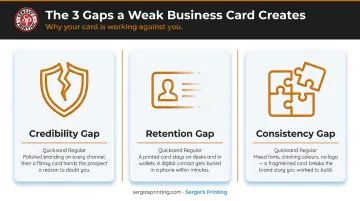
Three specific gaps emerge:
- Credibility gap: A generic card undercuts the impression built by a polished website, professional attire, or a confident introduction. Brand signals are cumulative; a weak card chips away at the overall picture even when everything else is strong.
- Retention gap: A number saved on the spot competes with hundreds of other contacts. A physical card left behind is a persistent, low-friction reminder that doesn't require the recipient to do anything to find it.
- Consistency gap: Entrepreneurs whose print materials don't match their digital presence — a mismatched logo, or no card when others expect one — create a fragmented brand experience that's hard to walk back.
Florida's 3.3 million small businesses (99.8% of all businesses in the state) means South Florida entrepreneurs are competing in one of the densest small-business environments in the country. In that context, brand consistency at every touchpoint — including a business card — isn't optional. It's the baseline.
How to Get the Most from Your Custom Business Cards
A well-designed card only works if it ends up in the right hands at the right moment. These three habits separate entrepreneurs who get follow-ups from those who hand out cards and hear nothing back.
Distribute with Purpose, Not Just at Events
The highest-value distribution moments aren't always formal networking events. Consider:
- After a service appointment or consultation
- When meeting a potential referral partner
- Leaving a small stack at local establishments relevant to your customer base
- Any face-to-face interaction where a connection is made
Design for Your Audience, Not Your Preferences
A card for a luxury wedding planner should feel premium and minimal. A card for a fast-casual food brand can afford more energy and color. The design should match what your target customer expects from a business in your category.
Sergio's Printing offers templates across more than a dozen industry categories — from Beauty & Spa and Food & Beverage to Events & Entertainment and Business Service — with matte, gloss, and spot UV finishes on 14 PT, 16 PT, and 18 PT cardstock. You can customize a template, build from scratch in the Designer Studio, or upload print-ready artwork directly.
Treat Cards as an Ongoing System
Once your design is set, treat your card supply as an active business tool rather than a one-time order:
- Track which networking contexts generate the most follow-ups
- Update the card when contact details, offers, or services change
- Reorder before running out — running low means missing unplanned opportunities
Conclusion
The benefits of custom business cards compound. A well-designed card builds credibility at first contact, creates a memorable physical moment in a networking exchange, and continues representing your business long after it's been handed out.
What makes the difference is the "custom" part. Brand consistency, design that fits your industry, and quality materials — all areas where a printer like Sergio's Printing can guide your choices — signal professionalism that a generic card simply can't match. For entrepreneurs focused on growth, a custom business card remains one of the lowest-cost, highest-return investments you can make.
Frequently Asked Questions
Why is it important for an entrepreneur to have a business card?
Business cards give entrepreneurs a professional, tangible way to make a first impression and ensure contact details are remembered. For solo founders and small business owners who are the face of their brand, the card directly represents personal credibility in every face-to-face interaction.
Do people still use printed business cards?
Printed business cards remain widely used in professional networking. In industries where everyone defaults to a LinkedIn request, a physical card is more memorable precisely because fewer people hand them out — a well-designed one stands out for that reason alone.
Are embossed or premium-finish cards worth it?
Premium finishes — spot UV, soft-touch, embossed text — are worth the added cost when perceived quality matters to your clients. For luxury services, creative fields, and high-value B2B work, the feel of a quality card signals that you take your business seriously in a way standard stock simply doesn't.
What information should an entrepreneur put on a custom business card?
Include the essentials: name, title or what the business does, phone number, email, and website or primary social handle. A QR code on the back linking to a portfolio or booking page adds practical value without cluttering the front.
What makes a custom business card stand out?
Standout cards combine brand-consistent design with a quality finish and purposeful content. A distinctive element — bold color, a memorable tagline, rounded corners, or spot UV on a key design feature — makes the card more likely to stay in a wallet or on a desk instead of being tossed.