According to Mordor Intelligence, the global customer communications management (CCM) market is valued at $1.96 billion in 2025 and is forecast to reach $3.33 billion by 2030, growing at an 11.18% CAGR. That growth reflects real demand: enterprises are replacing legacy batch-print systems with AI-enabled, omnichannel platforms — and the vendors supporting transactional communications are evolving with them.
Businesses that understand these shifts will communicate more effectively, reduce costs, and stay ahead of compliance. Those that don't will face mounting errors, rising postage costs, and eroding customer trust.
Key Takeaways
- AI and variable data are turning routine bills and statements into personalized customer touchpoints
- Physical mail and digital delivery are converging; omnichannel coordination is now a baseline expectation
- Automation has made fully streamlined print workflows a reality, cutting errors and accelerating turnaround
- Data security and vendor reliability are essential factors when choosing any print and mail partner
- USPS rate increases and delivery performance pressures make postal optimization a financial necessity, not an optional upgrade
AI-Powered Personalization Is Transforming Every Mailpiece
For most of print's history, a utility bill was a utility bill — same layout, same generic language, sent to everyone on the account list. That model is ending.
From Mail Merge to Dynamic Content
Variable data printing (VDP) has existed for decades, but its scope has expanded dramatically. Early VDP meant swapping a recipient's name and address into a fixed template. Today, AI-curated content blocks can adjust:
- Payment reminders with language tuned to an account's payment history
- Cross-sell messages triggered by usage data — for example, a utility surfacing a rebate offer when consumption spikes
- Segment-specific layouts that present information differently for seniors, Spanish-speaking households, or high-value account holders
- Healthcare EOBs that append a wellness prompt relevant to recent claims activity
The Transpromo Opportunity
Transpromo — embedding targeted promotional content inside transactional documents — is gaining traction for a straightforward reason: transactional mail commands extraordinary attention. USPS Delivers reports that 96% of people open and read bills, and 92% open and read statements — with recipients spending 2–3 minutes with transactional mail compared to just 15–20 seconds with a transactional email.
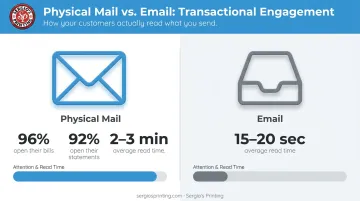
That attention gap makes the marketing message embedded in a statement far more likely to be seen than a standalone promotional email.
On-Brand Presentation Across Every Document
Personalization only converts when the document looks credible. A dynamically personalized statement loses its impact if the layout is generic, the logo is low-resolution, or the branding shifts between touchpoints.
For small businesses producing invoices, receipts, and order forms, maintaining consistent brand presentation is the foundation that makes any personalization effort land. Sergio's Printing's customizable NCR forms — available across Business Service and Industries template categories — let businesses apply their own logo, colors, and layout through the online Designer Studio, so every carbonless copy reflects the same professional identity as the rest of their printed materials.
Omnichannel Integration — Bridging the Physical and Digital Divide
Print versus digital is a false choice. In 2026, businesses that see results treat them as a single coordinated system — each channel reinforcing the other.
What Coordinated Delivery Looks Like
A coordinated outreach campaign doesn't send a postcard OR a follow-up email. It sends both — timed together, from the same campaign plan. In practice, a small business might run:
- A postcard or flyer mailed to a targeted neighborhood list
- An email or social post launched the same week reinforcing the same offer
- A follow-up text or digital ad timed to reach recipients after the mail lands
Every touchpoint reinforces the same message. Customers see the brand across channels, and the physical piece anchors recall in a way digital-only campaigns rarely achieve on their own.
Why Physical Mail Remains Central
Digital-only strategies leave real engagement on the table. The attention data is clear: physical mail holds reader focus longer than email. For local businesses — restaurants promoting a weekly special, real estate agents farming a neighborhood, contractors following up on estimates — a tangible piece in hand consistently outperforms a message that gets buried in an inbox.
Operational Benefits of a Unified Approach
Businesses that connect print and digital outreach gain measurable advantages:
- Eliminates redundant effort — one customer list drives both mail and digital outreach
- Speeds up campaign execution — physical pieces and digital assets go out together, not weeks apart
- Improves response rates — multichannel campaigns consistently outperform single-channel in direct-mail studies
- Stretches the budget — a single design adapted across postcards, flyers, and email reduces creative production costs
For small businesses running lean marketing operations, that efficiency compounds quickly across every campaign cycle.
Automation and End-to-End Intelligent Workflows
From Manual Processes to Near-Touchless Production
The transactional print workflow used to involve significant human handling at every stage. In 2026, automated environments handle most of it:
- Data intake and document composition — automated rendering from structured data files
- QA verification — cameras, sensors, and barcodes confirm the right document is in the right envelope before sealing
- Postage optimization — software calculates the most cost-effective rate for each piece in real time
- USPS handoff — presorted, manifested, and submitted with minimal manual intervention
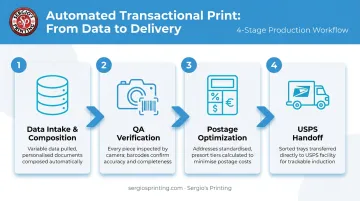
The result is faster throughput, fewer misfold and mismatch errors, and production runs that scale without proportional headcount increases.
USPS Infrastructure as the Automation Backbone
Two USPS systems underpin modern transactional mail automation:
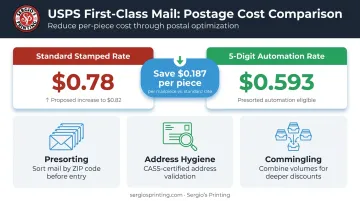
- Intelligent Mail Barcode (IMb): A 65-bar barcode required for automation pricing that sorts and tracks letters, cards, and flats through the postal network. Businesses qualify for significantly lower rates — the April 2026 5-digit automation rate of $0.593 versus the $0.78 stamped rate — when mail is prepared to IMb standards.
- Informed Visibility Mail Tracking & Reporting (IV-MTR): Provides near-real-time tracking for domestic letters and flats. Clients can see where a piece is in the postal network without calling a vendor.
Address hygiene is equally non-negotiable. USPS Move Update requirements ensure mailing lists reflect current addresses before mail enters the automation stream — directly reducing undeliverable mail costs.
The Case for Outsourcing
Maintaining in-house transactional print infrastructure — hardware, software, postal expertise, and certified staff — is expensive and hard to manage well. For most small businesses, outsourcing to a specialized print and mail partner is the more practical path — one that delivers automation-grade capabilities without the overhead of building them internally. That's especially true for high-frequency mailings like invoices, statements, and direct-mail campaigns where consistency and postal compliance directly affect delivery rates.
Sustainability and Data Security Are Becoming Baseline Expectations
Sustainability as a Procurement Filter
Businesses ordering print in 2026 — from local restaurants to real estate offices — are paying closer attention to how their materials are made. Environmental considerations that were once an afterthought are now part of the buying decision for a growing share of South Florida businesses.
The practices customers are increasingly asking about include:
- FSC-certified paper sourcing
- Recycled or responsibly sourced substrates
- Energy-efficient production facilities
- Digital proofing options that reduce paper waste before final print runs
A printer that can speak to these practices earns the order. One that can't is often passed over.
Security and Trust Certifications Are Non-Negotiable
For businesses ordering branded stationery, client-facing brochures, or direct mail, the printer handling that work has access to business names, addresses, and sometimes customer data embedded in the files. Trust matters.
The signals small businesses should look for when choosing a print vendor include:
- Secure file handling: Does the printer use encrypted upload portals or protected file transfer?
- Data retention policy: Are uploaded design files and customer data deleted after the job closes — or stored indefinitely?
- Physical security: Are print jobs handled in a controlled environment, with spoiled or misprinted materials properly destroyed?
- Business longevity: A printer with 30+ years of continuous operation has a track record that a newcomer doesn't.
These aren't enterprise-only concerns. A real estate agent uploading a client presentation or a medical office ordering patient-facing brochures should know how their files are handled.
Physical Security in Print Facilities
The physical side of print security is easy to overlook. Spoiled print runs, over-runs, and rejected proofs all create materials that carry real business information — and responsible shops have documented protocols for destroying them.
When evaluating a printer, it's reasonable to ask how they handle misprinted materials, who has access to files during production, and whether uploads travel over secure connections. A printer with a strong local reputation and decades of customer relationships has earned that trust the hard way — through consistent, accountable handling of every job.
What's Driving These Changes — and How They're Reshaping Business Operations
Four converging forces are reshaping how businesses produce and deliver transactional communications — and understanding them helps clarify where the industry is heading.
Technology Advances and AI Adoption
Cloud-based CCM platforms, AI-native document composition, and high-speed inkjet printing with roll-to-roll capabilities have made personalization at scale economically viable. Smaller organizations can now access capabilities via cloud APIs that once required dedicated mainframe infrastructure — without the capital investment.
Customer Expectations and Demographic Shifts
Gen Z and Millennials are now primary financial account holders. They expect every communication to be relevant, timely, and available in the format they prefer. Businesses sending generic, poorly formatted statements risk increased customer service call volumes and eroded trust — two costs that never appear on the print invoice.
Cost Pressures and Postal Economics
USPS rate increases have become a recurring operational pressure. Current First-Class Mail rates effective April 26, 2026 show a stamped letter at $0.78 — with a proposed increase to $0.82 effective July 12, 2026. Meanwhile, First-Class Mail on-time performance fell to 86.5% in FY 2024, adding delivery uncertainty to cost pressure.
The response is postal optimization: presorting to reach the $0.593 5-digit automation rate, address hygiene to eliminate undeliverable mail, and commingling to access volume discounts. Specialized outsourcing partners handle presorting logistics, address hygiene processing, and USPS vendor relationships — removing that operational burden from internal teams.
Regulatory and Compliance Dynamics
CFPB Regulation Z requires periodic statements for residential mortgage loans. Regulation F governs debt collection validation notices. State-level data privacy laws — Texas (effective July 1, 2024), Oregon (effective July 1, 2024), California's CCPA — add data handling obligations that affect how PII flows through the transactional print supply chain.
Non-compliance in any of these areas creates regulatory exposure that can dwarf the cost of the communications themselves.
Future Signals: What to Watch Through 2027
The trends driving change in 2026 are still early in their trajectory.
Variable-data personalization at the small-business level: Design tools that once required enterprise budgets are now accessible to local businesses. Postcards, brochures, and direct-mail pieces can be customized by recipient segment — neighborhood, purchase history, language preference — without large minimum order quantities.
QR code integration as standard practice: Static print is increasingly paired with trackable digital touchpoints. A door hanger with a QR code linking to a seasonal offer, or a postcard driving traffic to a landing page, turns physical mail into a measurable campaign rather than a one-way broadcast.
Multilingual compliance as a requirement: Census data shows that approximately 21.7% of U.S. residents age 5 and older speak a language other than English at home, with Spanish accounting for roughly 61% of that group. HHS already requires federally assisted programs to provide language assistance to people with limited English proficiency. As state-level requirements expand, bilingual print communications are shifting from a customer experience differentiator to a baseline compliance expectation — particularly across South Florida's Miami-Dade, Broward, and Palm Beach markets.
For businesses in that region, a local printer with an established English/Spanish workflow is a practical advantage, not just a convenience.
Print isn't going away — but what separates effective print from wasted spend is increasingly about relevance, timing, and language. Businesses that align their print strategy with those three factors now will be better positioned heading into 2027 than those still running one-size-fits-all campaigns.
Frequently Asked Questions
What is the difference between transactional print and direct mail?
Transactional print is triggered by specific account activity — a bill generated, a claim processed, a notice required — and contains personal, often regulated information. Direct mail is broadcast marketing sent to broad audiences without the same accuracy, privacy, or compliance requirements.
How is AI changing transactional print and mail services?
AI enables real-time personalization of document content, predictive payment messaging, and dynamic layout adjustments — so each recipient receives a communication tailored to their account behavior rather than a generic form letter.
What compliance certifications should a transactional print partner have in 2026?
SOC 2 Type 2, HIPAA, and — depending on your industry — HITRUST and PCI-DSS are the key certifications to verify. Always request third-party audit reports rather than accepting self-reported compliance claims.
How can businesses reduce transactional print and mail costs?
Start with postal presorting, commingling, and address hygiene — these cut postage costs and eliminate undeliverable mail without changing your workflow. From there, migrate willing customers to eStatements and partner with a high-volume provider that passes its postage discounts to you.
Is physical mail still relevant for transactional communications in 2026?
Yes — according to USPS research, 96% of people open and read bills, and transactional mail holds attention for 2–3 minutes versus 15–20 seconds for email. For regulated communications and demographics that prefer or require paper, physical mail remains essential.
What does omnichannel integration mean for transactional print?
It means coordinating physical mail, email, and SMS through a unified platform so customers receive communications in their preferred format. The result: a single compliance audit trail and no channel operating in isolation from the broader communication plan.