Introduction
You've spent an hour perfecting your listing flyer. The hero photo is sharp, the price is prominent, and the layout looks clean. But before you hit print, one question: does your footer have a proper disclaimer?
Many agents skip this step entirely, and the consequences range from license discipline to buyer disputes. According to NAR's 2026 Code of Ethics, agents must present a "true picture" in all advertising, including printed materials.
Missing required disclosures on a flyer carries real penalties. The Pennsylvania Real Estate Commission issued $3,400 in fines to a broker and agent whose ads lacked proper brokerage identification.
This guide covers what every real estate flyer disclaimer must include, ready-to-use templates you can copy today, and formatting rules that keep your flyers both compliant and professional.
Key Takeaways
- Brokerage name is legally required on all flyers in every US state — no exceptions
- Equal Housing Opportunity (EHO) logo or statement is required under Fair Housing guidelines
- "Deemed reliable but not guaranteed" is required for MLS-sourced data — and best practice on every flyer
- Virtually staged photos need a separate visible disclosure on the flyer
- Footer placement at 8pt minimum font is the industry standard for disclaimer text
Why Every Real Estate Flyer Needs a Disclaimer
The Legal Exposure Is Real
When a buyer makes decisions based on your flyer's price, square footage, or listed features — then discovers the information was wrong — they have grounds for a misrepresentation claim. A South Carolina appellate court affirmed a verdict of approximately $500,000 against a real estate professional who misstated a property's square footage.
The California Supreme Court's Horiike v. Coldwell Banker (2016) established that agents can be held liable for inaccurate property data disseminated in any advertising medium.
A properly worded disclaimer won't protect you from deliberate falsehoods, but it does create a meaningful defense against honest errors and data-lag situations — cases where printed information was accurate at press time but changed before the flyer reached a buyer.
What the Rules Actually Require
Three distinct regulatory frameworks apply to printed flyers:
| Requirement | Legal Status | Source |
|---|---|---|
| Brokerage name on all ads | Legally required — all US states | NAR SOP 12-5; FL, TX, CA, NC, NE state commissions |
| Non-discriminatory content | Legally required — federal | 24 CFR 100.75; Fair Housing Act |
| EHO logo or statement | Strongly recommended — compliance evidence | Former 24 CFR Part 109 (uses "should") |
| "Deemed reliable but not guaranteed" | Required for MLS data; best practice otherwise | NAR MLS Handbook, Section 13 |
| Measurements are approximate | Industry best practice | NAR guidance; NCREC; Fannie Mae |
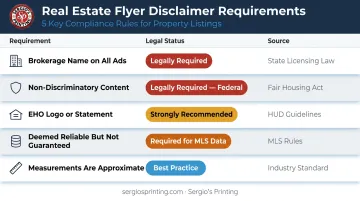
Key distinction on the EHO statement: 24 CFR 100.75 uses binding language — discriminatory advertising is unlawful. The EHO logo guidance uses advisory language ("should contain"). Treat the logo as mandatory in practice because HUD reviews its presence as evidence of compliance during investigations.
The Professionalism Angle
Legal compliance isn't the only reason to disclaim. According to RealTrends research, 77% of sellers interviewed only one REALTOR before hiring. Your flyer is often that first impression. A clean, properly disclaimed footer signals the same diligence buyers and sellers expect when you represent them.
Must-Have Disclaimers for Every Real Estate Flyer
Five disclaimers belong on virtually every real estate flyer. Each one addresses a distinct legal or compliance requirement — skip any of them and you're exposed to regulatory penalties, fair housing complaints, or buyer disputes.
Accuracy and Data Reliability Disclaimer
Property data moves fast. The price, days on market, or square footage printed on your flyer last Tuesday may be different by Friday. This disclaimer, the most universally used in the industry, establishes that your information came from reliable sources but carries no guarantee of ongoing accuracy.
Required on: listing flyers, farming flyers, open house flyers, and any piece reproducing MLS data. NAR's MLS Handbook explicitly requires "deemed reliable but not guaranteed" language on all printed materials using MLS-sourced information.
Equal Housing Opportunity Statement
Federal Fair Housing rules explicitly cover printed flyers as advertising materials. Include one of the following on every flyer:
- Full-page flyers (half-page or larger): The EHO logo (1" x 1" minimum for ads four column inches or larger; 2" x 2" for half-page or larger)
- Smaller formats: The phrase "Equal Housing Opportunity" as a text slogan
HUD provides print-ready EHO logos at 300 dpi on its website. Using the logo signals good faith compliance even though the specific guidance uses "should" rather than "shall."
Brokerage Name and License Disclosure
Every US state requires the licensed brokerage's full legal name on all advertisements. Individual agent names alone are not sufficient, and violations carry fines or license suspension depending on the state.
State-specific rules to know:
- Florida (FREC Rule 61J2-10.026): Team or group names must not appear in larger print than the brokerage name. Prohibited team-name words include "Realty," "Real Estate," "Company," and "Brokerage."
- Texas (TREC Rule 535.155): Broker name must appear in at least half the font size of the largest agent or team contact information.
- California (DRE): Responsible broker identity and license ID required on first-point-of-contact materials; team names must include "team," "group," or "associates."
- North Carolina (Rule A.0105): Flyers without the firm name count as prohibited "blind ads."
Measurements Are Approximate Disclaimer
Square footage figures on flyers typically come from tax records, MLS data, or prior appraisals — sources that frequently disagree. Fannie Mae adopted the ANSI Z765-2021 standard specifically because those discrepancies are common enough to affect valuations. Including "all measurements are approximate" shifts the verification responsibility to buyers.
Independent Verification Recommendation
Encouraging buyers to verify key details before calling sets accurate expectations from the start. A short line on the flyer recommending independent due diligence on items such as:
- Property inspections
- Boundary surveys
- Title searches and encumbrances
protects you against disputes and signals that you're a straightforward agent — not one who overpromises.
Ready-to-Use Disclaimer Templates for Real Estate Flyers
These four templates cover the most common real estate flyer formats. Copy the version that fits your layout, fill in the bracketed fields, and have your broker or a local real estate attorney confirm it meets your state's advertising rules before printing.
Standard Accuracy Disclaimer
The information contained herein has been obtained from sources deemed reliable but cannot be guaranteed for accuracy. All measurements are approximate. Prices, availability, and property details are subject to change without notice. Buyers are encouraged to independently verify all information prior to making any decisions.
Brokerage and License Disclosure
Licensed under [Brokerage Legal Name] | [State] License #XXXXXX | [Agent Name], [State] License #XXXXXX
Full Footer (Standard 8.5" x 11" Flyer)
The information herein has been obtained from sources deemed reliable but is not guaranteed for accuracy. All measurements are approximate and should be independently verified. Prices and availability are subject to change without notice. Buyers are encouraged to conduct independent due diligence including inspections, surveys, and title searches. [Brokerage Legal Name] | [State] License #XXXXXX | Agent: [Name], License #XXXXXX. Equal Housing Opportunity.

Pair this with the EHO logo in the footer corner for full compliance.
Short-Form Disclaimer (Half-Page, Postcard, or Rack Card)
Information deemed reliable but not guaranteed. All measurements approximate. Verify independently. [Brokerage Name] Lic. #XXXXXX. Equal Housing Opportunity.
This version fits the footer of smaller formats without crowding the design. It works well for half-page (5.5" x 8.5") flyers, postcards, and rack cards — all of which Sergio's Printing offers in print-ready formats.
Important: These templates are starting points. Have a local real estate attorney review your final disclaimer language before going to print to confirm it meets your state's specific advertising rules.
Where and How to Format Disclaimers on Your Flyer
Placement and Font Size
Standard placement is the footer zone — the bottom 10–15% of the page. Font size should be 8–9pt minimum. Sergio's Printing's print guidelines specifically caution against using fonts smaller than 8pt to ensure legibility in the final printed product.
"Small print" does not mean invisible. The disclaimer must be readable on the printed piece. A footer that's been greyed out to near-white on a light background, or placed over a busy photograph, fails the legibility test even if the font size is technically correct.
Formatting Best Practices
- Use a clean, non-decorative font that matches your flyer's body copy
- Maintain strong contrast between text and background (dark text on light background)
- Never place disclaimer text over a dark or busy photo
- Left-align the text block for readability
When designing your flyer, look for templates that include a dedicated footer zone, a clear design area reserved for this text so it doesn't compete with property photos or price callouts.
Sergio's Printing's flyer templates and Designer Studio let you add and position custom text blocks, including footer disclaimer sections, across all five flyer sizes (5.5" x 8.5", 8.5" x 11", 8.5" x 14", 9" x 12", and 11" x 17").
Disclaimer vs. Disclosure: Know the Difference
Once your formatting is locked in, there's one more distinction worth getting right before you print.
A flyer disclaimer limits liability for printed information. A seller's property disclosure is a separate legal document provided during the transaction. These serve different purposes. A flyer disclaimer cannot substitute for legally required seller disclosures, and confusing the two is a compliance error in itself.
Additional Disclaimers for Specific Flyer Types
Virtual Staging and Image Enhancement
If any flyer photo includes virtually staged furniture, digitally removed items, or enhanced images, add a visible disclosure. NAR Standard of Practice 12-10 prohibits misleading images, and NC REALTORS guidance requires "conspicuous disclosure" on any advertising using virtual staging.
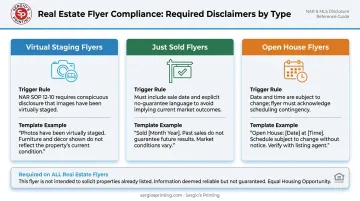
Template: Some images have been virtually staged for illustrative purposes. Furnishings shown are not included in the sale.
Place this as a watermark on the image itself, in the flyer footer, or both.
Just Sold Flyers
Just Sold flyers used for seller farming imply market expertise. Per NAR's MLS Handbook, printed materials using sale data must "clearly demonstrate the period of time over which such claims are based." Include:
- The date of sale
- A note that past sale prices are not a guarantee of future results for other properties
Template: Sold [Month, Year]. Past sale prices and market performance are not a guarantee of future results. Consult a licensed agent for a current market analysis.
Open House and Event Flyers
Event flyers present a different risk: open houses get cancelled, times change, and listings go pending. A single protective line covers all of it:
Template: Date, time, and availability are subject to change or cancellation without notice. Flyer details do not constitute a formal offer or agreement.
No NAR or state commission rule specifically mandates this language, but it's industry best practice that prevents disputes over cancelled showings before they start.
Frequently Asked Questions
What should a real estate flyer say?
Every listing flyer needs: property details (price, beds, baths, square footage), high-quality photos, agent contact info, brokerage name, a call-to-action, and a footer disclaimer covering data accuracy and Equal Housing Opportunity. The brokerage name and EHO statement are non-negotiable — everything else can be adjusted by flyer type.
What is a good disclaimer example?
Standard accuracy disclaimer: "The information contained herein has been obtained from sources deemed reliable but cannot be guaranteed for accuracy. All measurements are approximate. Buyers are encouraged to independently verify all details. Equal Housing Opportunity." Adding the EHO logo confirms compliance visually for both clients and regulators.
Are disclaimers legally required on real estate flyers?
The brokerage name is legally required in every US state; non-discriminatory content is federally mandated under 24 CFR 100.75. The EHO logo is strongly recommended as a compliance marker, while a general accuracy disclaimer — though not always mandated — protects against misrepresentation claims. Check your state's specific advertising rules for additional requirements.
Where should a disclaimer be placed on a real estate flyer?
The footer — bottom 10–15% of the page — in 8pt minimum font with strong contrast against the background. The text must remain legible in the final printed version; greyed-out or photo-overlaid text doesn't count as a proper disclosure.
What is the Fair Housing disclaimer for real estate flyers?
Include the Equal Housing Opportunity logo or the phrase "Equal Housing Opportunity" on every flyer. The EHO logo is available from HUD in print-ready formats. Using it affirms non-discriminatory practice and signals compliance with the Fair Housing Act to both clients and regulators.
Can I use the same disclaimer on all my real estate flyers?
A base accuracy/reliability disclaimer works across most flyer types. However, flyers with virtually staged images, Just Sold data, or open house events need additional type-specific language. Maintain one base template and add relevant clauses depending on the flyer's purpose.