Introduction
Over one million restaurants are competing for the same local customers. Great food gets you in the game — but it doesn't guarantee a full dining room or a steady stream of online orders.
Direct mail fills that gap. A postcard or menu mailer arrives in hand — not buried in a feed. For restaurants, where a single photo of a perfectly plated dish can trigger a craving and a reservation, that physical presence converts attention into action in a way a skippable ad rarely does.
This guide covers the formats that work best for restaurant direct mail, real campaign ideas with practical examples, design principles that drive response, and how to track what's actually working — so every mailing drives measurable results.
Key Takeaways
- Physical mail gets handled before it's discarded — a built-in advantage digital can't replicate
- Postcards, menu mailers, and door hangers each serve different campaign goals
- Stick to one mailer, one offer, and one call-to-action per campaign
- New movers, grand openings, and seasonal moments are the highest-ROI targeting windows
- Track results with unique coupon codes, QR codes, or dedicated landing pages
Why Direct Mail Still Works for Restaurants
The "direct mail is dead" argument doesn't hold up. A USPS generational study found that 41% of millennials would be very disappointed if they stopped receiving physical mail — a generation that supposedly lives entirely online.
The science backs this up too. Research from the USPS Office of Inspector General and Temple University found that physical ads produced stronger emotional responses, were remembered better, and activated the brain's ventral striatum — the region tied to perceived value and desirability. For restaurants, where appetite and aspiration drive decisions, that neurological edge is real.
The Tangibility Advantage
An email takes one click to delete. A mailer requires a physical decision.
That moment of physical handling matters for three reasons:
- Recipients see your offer even if they only glance before setting it down
- A well-shot food photo triggers appetite in a way a banner ad rarely does
- The mailer stays in the home until someone acts on it or consciously discards it
A glossy postcard with a well-shot plate of food sitting on a kitchen counter does something a retargeting ad can't: it stays there until someone acts or throws it away. For local restaurants fighting for neighborhood attention, that dwell time is an advantage worth paying for.
Best Direct Mail Formats for Restaurants
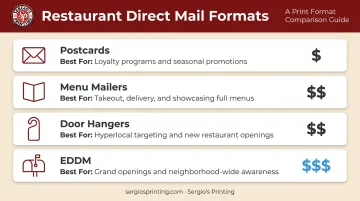
Postcards
Postcards are the most practical entry point for restaurant direct mail. No envelope to open, the offer is visible immediately, and the format is cost-effective enough to mail repeatedly.
The best approach: use one side as a visual hook — a single hero food image or a bold offer in large type — and the other for the offer details, expiration date, and contact information.
Postcards work particularly well for:
- Monthly loyalty touchpoints with existing customers
- Seasonal promotions tied to specific dates
- Re-engagement campaigns targeting lapsed guests
Sergio's Printing offers restaurant postcard templates in 4" x 6" and 5" x 7" sizes, with both horizontal and vertical orientations. Their Food & Beverage template category includes designs purpose-built for restaurant promotions, and finishing options include glossy, matte, and spot UV — all of which enhance food photography reproduction.
Menu Mailers and Brochures
A printed menu mailed to nearby households is a longer-term investment. Many recipients keep them in a kitchen drawer and pull them out when they want to order takeout — making this format ideal for delivery and takeout-focused restaurants.
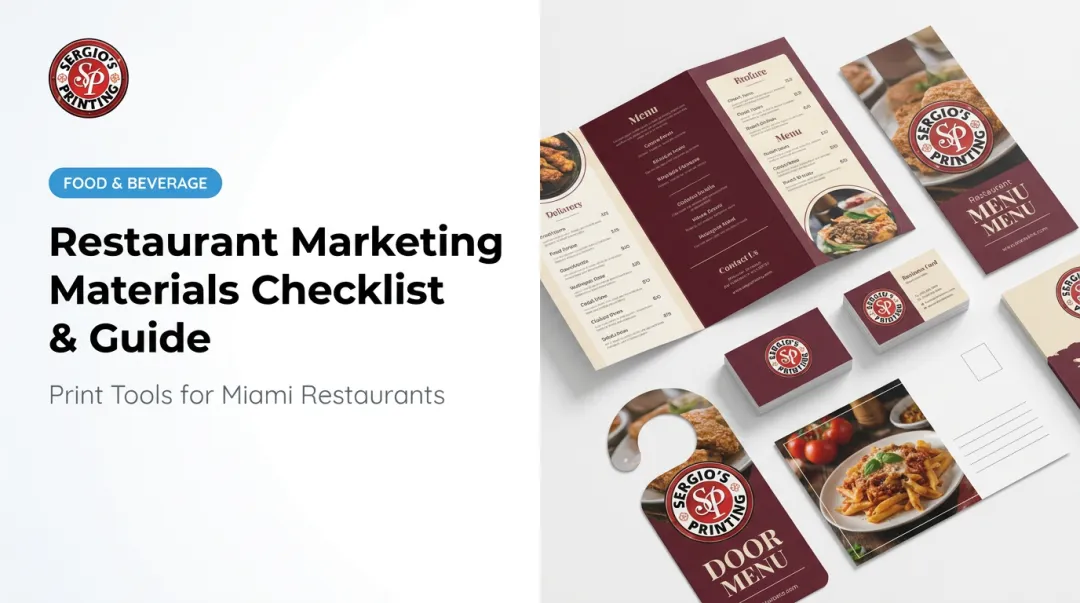
Sergio's Printing offers brochures in multiple sizes, including a 6-page booklet format. Their Food & Beverage template category gives restaurant owners a print-ready starting point without needing a full design team.
Key inclusions for menu mailers:
- Featured seasonal dishes with pricing
- Ordering instructions (phone, online, app)
- A coupon or introductory offer to prompt first-time action
- Hours, address, and delivery radius
Door Hangers
Door hangers are a hyperlocal complement that works especially well for new openings or delivery zone expansions. A time-limited offer on a door hanger placed on every door within a two-block radius is hard to ignore.
Sergio's Printing offers door hangers in three sizes — 3.5" x 8.5", 4.25" x 11", and 4.25" x 14" — with Food & Beverage templates including designs like "Fun Pizza," "Tasty Bites," and "Dine-In Dreams."
Every Door Direct Mail (EDDM)
EDDM is a USPS program that lets restaurants mail to every address on a selected carrier route — no purchased mailing list required. Mailpieces are addressed to "Postal Customer" and delivered to all addresses on chosen routes.
Key EDDM facts from USPS:
- Postage rate: as low as $0.242 per piece for USPS Marketing Mail flats (BMEU)
- Minimum: 200 pieces per mailing; up to 5,000 per day per ZIP code
- Size: Flat pieces up to 3.3 oz, at least one dimension exceeding standard letter size
Those specs make EDDM a practical fit for grand openings, new delivery zone launches, or broad neighborhood awareness campaigns where budget is a priority.
Restaurant Direct Mail Campaign Ideas
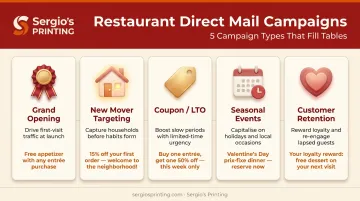
Grand Opening and New Location Announcements
A grand opening mailer has one job: get people through the door in the first 30 days.
Lead with a strong incentive — a free appetizer, a first-order discount, or a buy-one-get-one offer — and mail to every household within a defined radius of the new location. The inherent novelty of a new restaurant supports urgency naturally, but a hard expiration date ("Valid through [date]") makes the timeline explicit.
EDDM is a natural fit here: blanket the surrounding neighborhood without needing to build a list first.
New Mover Targeting
New residents are one of the most receptive audiences for local restaurant marketing. Vericast reported that approximately 30 million people move each year, and 90% of new movers are open to trying new brands and local businesses.
A "Welcome to the neighborhood" postcard with an introductory offer hits at exactly the right moment — before new residents have established their go-to spots. Once they try you and have a good experience, loyalty follows.
Coupon and Limited-Time Offer Campaigns
Coupon mailers work when the offer is singular and the urgency is clear.
High-performing offer types:
- Free appetizer or dessert with any entrée
- 15–20% off a first order
- Buy-one-get-one on a featured dish
- Bonus loyalty points on the next visit
One rule applies to non-coupon promotional pieces: carry a single offer only. Multiple competing calls-to-action on the same piece increase the likelihood that the recipient does nothing at all.
Seasonal and Event-Based Mailers
Seasonal demand is real. The National Restaurant Association reported that 52% of individuals planned to visit a restaurant for Mother's Day dinner. Valentine's Day consumer spending on dining averages in the hundreds of dollars per couple.
These demand spikes are predictable — which means restaurants can plan and mail 10–14 days ahead to be top-of-mind when decisions are made.
Strong seasonal mailing moments:
- Valentine's Day (reservation-focused, prix-fixe promotions)
- Mother's Day (group dining, gift card promotions)
- Holiday party season (corporate and private event bookings)
- New menu launches and chef's tasting events
Customer Retention and Loyalty Campaigns
Acquiring a new customer costs 5 to 25 times more than retaining an existing one, according to Harvard Business Review. Direct mail is a cost-effective retention channel when used consistently.
Retention campaign formats that work:
- Monthly postcards with a featured dish and a seasonal offer
- Birthday mailers with a personalized discount valid for 30 days
- "We miss you" postcards to guests who haven't visited in 90+ days
- Loyalty program invitations with a points bonus for first use
Birthday mailers deserve special attention: they're personalized, arrive at a moment that matters, and make recipients feel recognized rather than marketed to. That combination drives measurably higher redemption rates than standard promotional mail.
Design Best Practices for Restaurant Mailers
A restaurant mailer has roughly two seconds to earn attention before it ends up in the recycling bin. The right design choices — hierarchy, photography, copy, and offer treatment — are what make those two seconds work.
Visual Hierarchy
Structure every mailer in this order:
- Headline — lead with the offer or the hook, not the restaurant name
- Subheadline — reinforce quality or positioning ("Handmade pasta, delivered to your door")
- Offer — visually dominant, clearly separated from body copy
- Single CTA — one action: visit, order online, call to reserve
The offer — not the logo — should be the first thing a reader's eye lands on.
Food Photography
Choose one or two high-quality food images that represent your best or most profitable dishes:
- One aspirational shot of a perfectly plated entrée consistently outperforms a grid of six mediocre photos
- Glossy or UV-coated print finishes add depth and vibrancy to food photography that matte stock can't replicate
Copy and Typography
- Keep body copy short: two to three sentences maximum
- Never reduce font size to fit more content — reduce the content instead
- Limit the piece to two font styles across the entire design
- If it requires effort to read, the recipient won't read it
Making the Offer Stand Out
The offer should be visually distinct from everything else on the mailer:
- Use a contrasting color or a call-out box
- Apply bold weight or a larger font size
- Add a graphic element (arrow, starburst, or border) that directs the eye
- Never let the offer compete visually with the headline or the food photo
Common Mistakes to Avoid
Most restaurant direct mail campaigns fall short for predictable reasons. Watch for these three:
- Too many CTAs on one piece. When recipients weigh "visit us," "order online," and "follow us on Instagram" at the same time, they usually do nothing. One mailer, one purpose, one CTA.
- Treating it as a one-time test. A single mailing rarely generates meaningful return. Plan a sequence of three to four sends before judging whether a concept is working — consistent exposure builds familiarity faster than any single drop.
- Skipping list hygiene. Outdated addresses waste budget and skew response data. Clean your list before each campaign cycle, and segment it: existing customers need different messaging than cold prospects.
Targeting, Frequency, and Measuring ROI
Targeting Options
| Method | Best For |
|---|---|
| EDDM (geographic routes) | Grand openings, broad neighborhood awareness |
| ZIP code or carrier route targeting | Delivery zone promotions |
| Demographic targeting (age, income, family size) | Family-friendly vs. fine dining positioning |
| Customer lists (existing or lapsed) | Retention, loyalty, re-engagement |
| New mover lists | Acquisition campaigns |
The more precisely you define the audience, the more relevant the offer can be — and relevance drives redemption.
Mailing Frequency
A sustainable cadence for most restaurants is once every four to six weeks. This keeps the restaurant visible without fatiguing the audience or pushing postage costs out of proportion to return.
For seasonal campaigns or grand openings, a denser sequence (three touches in six weeks) makes sense. For retention campaigns, monthly postcards strike the right balance.
Tracking and Measuring Results
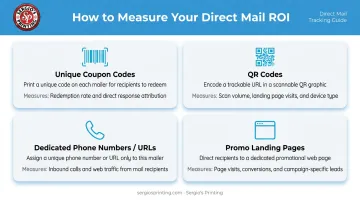
Direct mail is measurable when you build tracking into the design from the start:
- Unique coupon codes — each mailing gets its own code; redemption rates are visible
- QR codes — link directly to your online ordering page, reservation system, or a landing page specific to that campaign
- Dedicated phone numbers or URLs — route responses from each mailing separately to attribute volume accurately
- Promo-specific landing pages — track visits and conversions tied to a specific offer
To identify which incentives drive the most traffic, run two versions of the same mailer with different offers to comparable segments. The results tell you exactly what to lead with next time — and which offers to retire.
Frequently Asked Questions
How much does restaurant direct mail marketing typically cost?
Costs vary based on format, quantity, and postage method. EDDM postage runs as low as $0.242 per piece through USPS for qualifying flat-size pieces. Total per-piece costs also include printing, finishing, and optional mailing list acquisition — postcards are generally the most budget-accessible format.
How often should a restaurant send direct mail?
Every four to six weeks works well for most restaurants. That cadence maintains visibility without overwhelming recipients and keeps postage costs manageable.
What is EDDM and is it worth it for restaurants?
Every Door Direct Mail is a USPS program that delivers to every address on selected carrier routes — no purchased list required. For restaurants targeting a specific neighborhood or delivery zone, it's hard to beat at under $0.25 per piece in postage.
What offer works best on a restaurant direct mail piece?
Time-limited single offers consistently outperform multiple competing deals. A free appetizer or a percentage off a first order with a clear expiration date tends to drive the strongest response.
How do I measure the success of a restaurant direct mail campaign?
Unique coupon codes, QR codes linked to a campaign-specific landing page, and dedicated promo phone numbers each tie redemptions directly to the mailing that generated them.
Can direct mail work for small restaurants with a limited budget?
Yes. EDDM and postcard campaigns are accessible at almost any scale. A targeted mailing of 500 to 1,000 postcards to households within a defined radius, with a compelling single offer, can generate measurable foot traffic and order volume without a large budget.