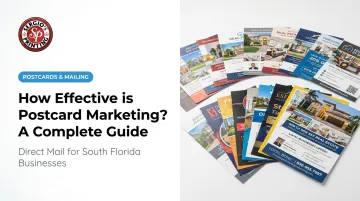
Unlike an email, a postcard doesn't need to be opened. Unlike a digital ad, it doesn't compete with 15 others on the same screen. The moment someone picks up their mail, your message is already in front of them.
This guide examines how effective postcard marketing actually is — covering its structural advantages, what the research says about ROI and response rates, and how to run campaigns that compound in value over time.
Key Takeaways
- Postcards deliver guaranteed message visibility — no envelope means no open-rate problem
- USPS EDDM postage starts at just $0.247 per piece, making postcards one of the most affordable direct mail formats
- Direct mail to house lists generates 161% ROI and a 15.6% response rate, per the ANA's 2023 Response Rate Report
- Personalized direct mail can lift response rates by up to 135% compared to generic campaigns
- Consistency matters more than any single send; planned cadences outperform one-off blasts
What Is Postcard Marketing?
Postcard marketing is a direct mail strategy where businesses send printed, single-card mailers to a targeted list — with the offer fully visible, no envelope required.
It works across virtually every business type and campaign goal. Businesses apply it across:
- Local promotions and flash sales
- Product launches and seasonal campaigns
- Event invitations and appointment reminders
- Win-back campaigns for lapsed customers
- New customer acquisition via neighborhood saturation mail
The key distinction is that postcard marketing is a means to a specific business outcome — a visit, a call, a scan, a purchase — not just "sending mail." Campaigns built around a clear, measurable action consistently outperform those built around general awareness.
Key Advantages of Postcard Marketing
High Engagement and Guaranteed Visibility
Postcards have a structural advantage no digital channel can replicate: because there's no envelope, USPS confirms the message is immediately visible the moment a recipient handles the mail.
This matters because the single biggest drop-off point in most marketing funnels is the decision to engage in the first place. Email campaigns live or die by subject lines. Digital ads compete with dozens of others simultaneously. A postcard bypasses both problems — the offer is readable before the recipient makes any conscious choice.
What this means in practice:
- Every piece mailed has a real chance of being seen
- Budget allocation becomes more predictable (no budget lost to unopened emails)
- Time-sensitive campaigns — flash sales, event invitations, limited-time offers — land with full impact rather than sitting unread in an inbox
That said, guaranteed visibility only gets you so far. Without strong design and a clear offer, the card still ends up in the recycling bin — which means visual execution carries more weight here than in almost any other format.
Cost-Effectiveness and Strong ROI
Postcard marketing is consistently one of the most affordable direct mail formats. The cost structure is straightforward:
| Cost Component | Typical Cost |
|---|---|
| EDDM Retail postage | $0.247 per piece |
| EDDM BMEU postage | As low as $0.242 per piece |
| First-Class postcard stamp | From $0.61 |
| First-Class letter stamp | From $0.78 (for comparison) |
| Printing (typical range) | $0.32–$0.45 per piece |
No envelope, no insert, no extra assembly — postcards are simply cheaper to produce and mail than letter-format campaigns.
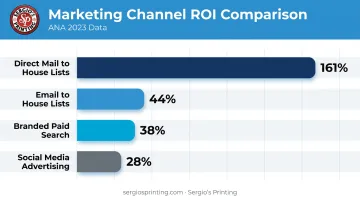
The ROI numbers back this up. The ANA's 2023 Response Rate Report shows direct mail to house lists generates 161% ROI and a 15.6% response rate. For context, email to house lists delivers 44% ROI in the same report, branded paid search 38%, and social media advertising 28%.
Postcards specifically produced 92% ROI to house lists in ANA's 2021 data — making them the strongest-performing format for existing customer mailings.
For businesses working with limited marketing budgets, the math is forgiving. At under $0.25 per piece for EDDM saturation mail, even a modest response rate on a 5,000-piece campaign can return multiples of the investment.
Targeting, Personalization, and Brand Recall
Postcards offer three distinct targeting approaches:
- Mail to your existing customer house list, where response rates are highest and wasted impressions are lowest
- Use purchased prospect lists filtered by demographics like age, income, homeowner status, or geography
- Choose EDDM route saturation to reach every address on selected postal routes — no list required
Beyond targeting, modern variable data printing allows each card to carry personalized names, offers, and calls to action. Research from Lob shows personalized direct mail can lift response rates by up to 135%. Even aligning offers more closely with recipient motivations — without full personalization — can move response rates by double digits, according to SG360.
Physical mail also creates stronger brand recall than digital. Canada Post's neuromarketing research found that physical direct mail required 21% less cognitive effort to process and produced 70% higher brand recall than digital media. Integrated campaigns combining direct mail and digital drew 39% more attention and 40% higher brand recall than digital-only approaches.
For South Florida businesses looking to act on these advantages, Sergio's Printing offers postcard printing in 4"x6" and 5"x7" sizes with an online template library spanning 16 industry categories — from Food & Beverage and Beauty & Spa to Real Estate and Events & Entertainment. Campaigns can be designed, customized, and ordered without a separate design agency.
What Happens When Postcard Marketing Is Missing or Ignored
Running no postcard campaigns — or running them without structure — produces predictable results.
Inconsistent brand presence. Local businesses lose ground when physical touchpoints disappear from the mix. Not every customer follows a business on social media or checks email regularly — a postcard reaches them regardless.
Weak response rates that get blamed on the format. One-time mailings to untargeted lists produce poor returns. Businesses often conclude "postcards don't work" when the real culprit is a bad list, a weak offer, or no clear call to action.
Missed conversion data. Campaigns without trackable response mechanisms — QR codes, promo codes, dedicated URLs — leave response rates unknown. Without that data, there's no way to improve the next send or justify continued spend.
How to Get the Most Value from Postcard Marketing
Postcard marketing performs best as an ongoing practice, not a one-time blast. Each element of a campaign — list quality, design, offer, CTA, timing — directly affects results.
Mail consistently. Repeated mailings to the same list build familiarity and credibility. Industry guidance from Lob suggests most programs perform well mailing the same audience every 3 to 6 weeks. A quarterly cadence works well for retention; monthly for active promotions. Ad hoc sends rarely build momentum.
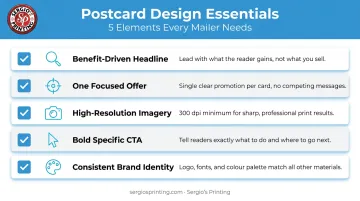
Prioritize design and print quality. A postcard's visual impact is its only impression. Essentials include:
- A clear, benefit-driven headline
- One focused offer (not three competing messages)
- High-resolution imagery
- Bold, specific CTA — QR code, phone number, URL, or promo code
- Consistent brand colors and logo placement
Sergio's Printing carries ready-to-customize postcard templates across 16 industry categories in both 4x6 and 5x7 formats, with orders starting at 100 pieces and standard turnaround of 3–4 business days.
Track and refine. Every send should include a measurable response mechanism:
- QR code linking to a campaign-specific landing page, a promo code, or a dedicated phone number
- Conversion tracking against campaign cost after each send
- Data review to sharpen list targeting, messaging, and timing before the next mailing
Conclusion
Postcard marketing's effectiveness is grounded in measurable outcomes: guaranteed visibility, strong ROI relative to most digital channels, and brand recall that inbox-based campaigns consistently struggle to match.
The advantages compound when campaigns are run with consistency: the right list, a focused offer, professional print quality, and a trackable CTA. Each send builds on the last, strengthening recognition and response over time.
Treat postcard marketing as an ongoing channel in your marketing mix, not a one-time experiment. Even modest, well-targeted campaigns — a few hundred pieces to a quality house list — can generate response rates that outperform comparable email or social spend.
If you're ready to put a campaign together, Sergio's Printing offers postcard printing in 4×6 and 5×7 sizes with templates across 16 industry categories, plus mailing services for direct-mail outreach. Order online or call (305) 971-4161 to get started.
Frequently Asked Questions
Do postcard mailers work?
Yes. Postcards have a structural visibility advantage (no envelope barrier) and produce strong ROI. The ANA's 2023 data shows direct mail to house lists delivers 161% ROI and a 15.6% response rate — outperforming email, paid search, and social media in the same report.
How much does it cost to do a postcard mailer?
The two main costs are printing ($0.32–$0.45 per piece) and postage — USPS EDDM starts at $0.247 per piece for saturation mail, while First-Class postcard stamps run from $0.61. Most campaigns land well under $1.00 per piece, with final pricing varying by size, quantity, and paper stock.
What is the response rate for postcard marketing?
Response rates vary by list quality and campaign type. The ANA's 2023 Response Rate Report shows direct mail achieving 15.6% response to house lists and 10.8% to prospect lists — offer strength, targeting, and design drive the difference.
What should be included in a marketing postcard?
Every postcard needs a strong headline, one focused offer, compelling visuals, clear contact information, and a specific CTA — whether that's a QR code, promo code, URL, or phone number. Limit yourself to one clear ask; crowding a postcard with multiple messages dilutes response rates.
How do I measure the success of a postcard marketing campaign?
Build trackable tools into every send: a QR code linked to a campaign-specific landing page, a dedicated phone number, or a promo code. Track conversions against total campaign cost to calculate ROI — and use those numbers to refine the next send.
How often should I send postcards to customers?
Consistency matters more than frequency. Most programs perform well mailing the same audience every 3 to 6 weeks, per Lob's industry guidance. For most small businesses, a monthly cadence for active promotions and quarterly for retention programs is a practical starting point.