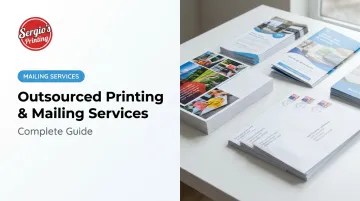
This guide covers what outsourced printing and mailing actually means, where in-house operations quietly drain money and time, the concrete benefits of outsourcing, what materials make sense to hand off, and how to find a provider worth trusting.
Key Takeaways
- Outsourcing print and mail frees your team from repetitive production work and reduces hidden overhead costs
- Professional providers deliver better print quality, faster turnaround, and postage savings most small businesses can't access alone
- Postcards, flyers, brochures, invoices, menus, booklets, and more can all be outsourced
- Look for providers that combine design tools, mailing expertise, and dependable delivery with the flexibility to handle both small runs and large orders
What Is Outsourced Printing and Mailing?
Outsourced printing and mailing means hiring a third-party provider to handle the design, production, finishing, and delivery of physical materials — instead of doing it yourself with in-house equipment and staff.
Most businesses need two categories of printed materials:
- Marketing mail — postcards, flyers, promotional mailers, menus, event invitations, and brochures
- Transactional mail — invoices, statements, appointment reminders, notices, and compliance letters
Modern outsourcing doesn't require visiting a print shop. Providers like Sergio's Printing offer online ordering platforms where you can upload a design, customize a template, or design from scratch — making it practical for businesses of any size, from a neighborhood restaurant to a regional retailer running seasonal campaigns.
The True Cost of Managing Print and Mail In-House
Most business owners underestimate what in-house printing actually costs. The hardware is just the beginning.
Hardware and Supplies
Business-grade office printers from reputable brands run anywhere from $549 to $800 for the unit alone, according to PCMag's 2026 printer roundup. Operating costs vary by model — color printing on an HP Color LaserJet Pro runs about 15.2 cents per page, compared to 2 cents per page for the Epson EcoTank Pro. Add paper, envelopes, maintenance calls, and eventual hardware replacement, and the costs compound fast.
Staff Time
Every hour an employee spends printing, folding, stuffing envelopes, and running to the post office is an hour not spent serving customers or growing the business. SCORE reports that 33% of small business owners already work more than 50 hours per week — absorbing print and mail tasks into that schedule isn't neutral.
Postage Inefficiency
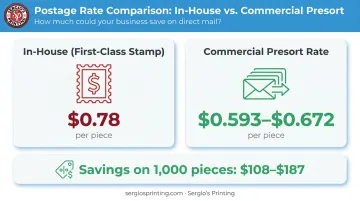
A standard retail First-Class stamp costs $0.78. Commercial automation rates through a qualified mail provider drop to $0.593–$0.672 per piece, depending on sort level — per current USPS Notice 123 pricing. On a mailing of 1,000 pieces, that's $108–$187 in postage savings alone.
Quality and Error Costs
In-house printing introduces quality and delivery risks that are easy to overlook until they cost you:
- Inconsistent color output as toner depletes — menus or flyers printed in batches won't match
- Blurry or low-resolution text that undercuts your brand credibility
- Outdated mailing addresses that send pieces to the wrong recipients at full postage cost
Scalability Problems
In-house setups hit a ceiling fast. A seasonal sale campaign or holiday mailing that requires 2,000 pieces stresses an office printer built for 4,000 pages per month. The result is either rushed, inconsistent output or a delayed campaign.
Key Benefits of Outsourcing Your Printing and Mailing
Cost Savings at Scale
Commercial printers buy paper, ink, and supplies in bulk — at volumes no small business can match. Those lower input costs translate directly into lower per-piece pricing for clients. When you add postage savings from presort discounts, the total cost advantage over in-house production is substantial.
Professional Print Quality
There's a meaningful difference between what a commercial digital press produces and what an office printer outputs. Commercial equipment delivers consistent color matching, sharp resolution, and clean finishes — glossy, matte, or spot UV coating — that aren't replicable in-house. For brand-sensitive materials like restaurant menus, event programs, or promotional mailers, this matters.
Faster, Predictable Turnaround
Dedicated production workflows mean outsourced providers can turn jobs around in days, not weeks. Sergio's Printing, for example, offers standard production in 3–4 business days with next-day options available for select products. When you're working around an event date or seasonal window, predictability is non-negotiable.
Scalability Without the Headaches
Need 500 postcards this month and 5,000 next quarter? An outsourced provider handles that swing without any equipment changes or overtime on your end. This flexibility is particularly valuable for restaurants, event companies, retailers, and nonprofits with fluctuating campaign volumes.
Fewer Undeliverable Pieces
Professional mail providers use address validation tools to keep your list clean and your spend efficient:
- CASS certification confirms each address format is correct against the USPS database before anything goes to print
- NCOA processing cross-references approximately 160 million change-of-address records filed with USPS, flagging anyone who has moved so mail doesn't land at the wrong address
Together, these checks reduce undeliverable pieces and lower your cost per delivered piece.
Types of Print and Mail Materials Businesses Commonly Outsource
Marketing Materials
These are the highest-volume category for most small businesses:
- Postcards for direct mail campaigns, seasonal promos, and EDDM outreach
- Flyers covering local promotions, event announcements, and in-store handouts
- Brochures for service overviews, product catalogs, and multi-panel informational pieces
- Self-mailers — folded pieces that mail without an envelope, used for events or announcements
USPS research found that 66% of surveyed marketers used postcards and newsletters, and 56% used self-mailers — making these the most widely adopted direct mail formats. Retail, food and beverage, real estate, and events businesses use these most heavily.
Business and Transactional Documents
Service businesses, healthcare offices, and financial providers regularly mail:
- Invoices and billing statements
- Appointment reminders and confirmations
- Compliance and regulatory notices
- Client correspondence
These pieces don't carry the visual weight of a promotional mailer, but the stakes are just as real — a missed invoice or undelivered compliance notice creates downstream problems that cost far more to fix than the mailing itself.
Brand and Identity Materials
Print quality is most visible here, because these pieces represent the business before anyone speaks a word:
- Menus, reprinted seasonally by restaurants updating pricing or offerings
- Booklets and catalogs for multi-page product or service guides
- Event programs distributed at conferences, weddings, and performances
- Presentation folders used by real estate agents, professional services firms, and B2B companies
Sergio's Printing offers customizable templates across industry categories including Food & Beverage, Beauty & Spa, Fashion & Retail, Business Service, and Events & Entertainment. Businesses without an in-house designer can select from those templates and personalize colors, logos, and copy directly in the online design tool.
How to Choose the Right Outsourced Printing and Mailing Partner
Not all print providers are equal. USPS Delivers recommends asking whether a provider can handle design, printing, presorting, and delivery — because a provider who only prints leaves you managing the rest yourself.
Here's what to evaluate:
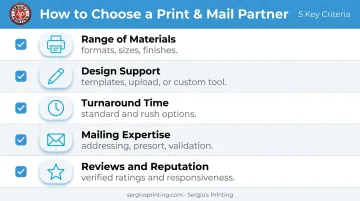
Range of materials and formats — Confirm the provider handles the specific products you need: postcards, booklets, envelopes, flyers. Check that they support different sizes, paper stocks, and finishes. A limited catalog forces workarounds.
Design support — If you don't have a print-ready file, look for a provider with an online design tool or template library. Sergio's Printing, for example, offers three pathways: upload your own file, pick and personalize a template, or design from scratch using their Designer Studio.
Turnaround time — Ask specifically about standard and rush options. For time-sensitive materials — event invitations, seasonal sales, compliance notices — you need a provider with a documented track record of meeting deadlines.
Mailing expertise — If you need full-service mail delivery (not just printed pieces), ask whether the provider handles addressing, postage, USPS presort discounts, and address validation. These details directly affect both cost and deliverability.
Reviews and reputation — A 4.9-star rating across 250+ verified reviews — as Sergio's Printing holds — is a concrete trust signal. Look for consistent mentions of quality, turnaround, and responsiveness, not just a high average.
Frequently Asked Questions
What types of businesses benefit most from outsourced printing and mailing services?
Retailers, restaurants, nonprofits, real estate firms, healthcare providers, and service businesses all benefit — especially those mailing in volume or needing consistent, brand-quality output without investing in commercial printing equipment.
How much does outsourced printing and mailing typically cost?
Costs vary by material type, quantity, finish, and whether mailing is included. Commercial per-piece pricing is often lower than true in-house cost once equipment, labor, and retail postage are factored in. Request a quote for pricing specific to your job.
Can I customize my designs when using an outsourced printing service?
Most modern providers offer online design tools and template libraries. At Sergio's Printing, you can choose a professionally designed template, customize it using the online design tool, or upload your own print-ready file — without needing separate design software.
What is the typical turnaround time for outsourced printing and mailing?
Turnaround varies by provider, product type, and order volume. Contact Sergio's Printing directly to confirm current production times for your job — especially for time-sensitive campaigns.
Is outsourced printing and mailing worth it for small businesses?
Yes — outsourcing eliminates upfront hardware costs, reduces per-piece pricing, and delivers professional-quality output. For volume mailers, postage savings alone often justify the switch.
What should I send to a print provider to get started?
Most providers need your design file (or will help you build one using templates), your mailing list if applicable, and your job specifications — quantity, size, paper stock, finish, and delivery timeline. Specifying details like file format, paper stock, and quantity upfront helps avoid back-and-forth and speeds up production.