This guide covers exactly how to plan and execute a local postcard campaign: how to define your zone, choose the right targeting method, design for response, and track what actually works. It also covers the preparation steps that determine whether a campaign succeeds before a single card is mailed.
Key Takeaways
- Define your service radius first, then use EDDM or a targeted mailing list to reach every household within it
- EDDM covers every address on a carrier route at $0.247 per piece; targeted lists filter by demographics but require more setup
- A strong offer, clear design, and consistent follow-up matter more than raw volume
- Set up QR codes, unique promo codes, and dedicated phone numbers before postcards go to print — these are your response-tracking tools
- Businesses that plan in 2–3 mailing waves consistently outperform those treating postcards as a one-time drop
How to Target Local Customers With Postcard Campaigns
Step 1: Define Your Local Target Area
Before choosing a mailing method, map your realistic service area. The right radius depends on your business type:
- Restaurants, gyms, salons, pet groomers: 1–3 miles — customers visit regularly and won't travel far
- Home services (contractors, cleaners): 5–10 miles — service area extends further, but still bounded
- Specialty retail: 3–5 miles — destination shopping expands the radius slightly
Once you have a rough radius, translate it into ZIP codes, carrier routes, or neighborhood boundaries. The free USPS EDDM mapping tool lets you visualize carrier routes, see exact residential and business address counts, and filter by Census-based demographics like age, income, and household size.
Use actual route counts from the tool rather than estimating — they vary significantly by neighborhood.
Step 2: Choose Your Targeting Method — EDDM or a Targeted Mailing List
Two methods get postcards to local households. They solve different problems.
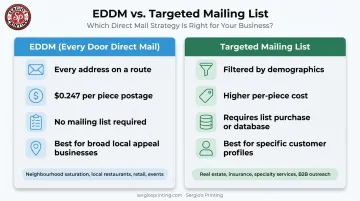
EDDM (Every Door Direct Mail)
- Mails to every address on a USPS carrier route — no mailing list needed
- USPS lists EDDM Retail Marketing Flats at $0.247 per piece, significantly lower than the $0.61 retail First-Class postcard rate
- Requires a minimum of 200 pieces per mailing
- Best for: restaurants, gyms, salons, retail — businesses whose ideal customer is simply "anyone nearby"
Targeted Mailing List
- Filters households by demographics (age, income, homeowner status, pet ownership) within your zone
- Purchase a list from a broker or use your own customer database
- Higher per-piece postage than EDDM, but sharper audience match
- Best for: businesses whose customer matches a specific profile — a pet grooming service targeting pet-owning households, for example
Most list providers and the USPS EDDM tool let you estimate qualifying address counts before committing to print quantities — check those numbers before ordering.
Step 3: Design Your Postcard for Local Relevance
The headline is the most important element on your postcard. It should answer one question immediately: what's in it for me? A postcard leading with the business name and nothing else loses the reader before they finish the front.
What makes a local postcard design work:
- Lead with a benefit or offer — "Free consultation for Doral homeowners" beats "Now Open in Doral"
- Include a local signal — a neighborhood name, nearby landmark, or community event tie-in increases relevance and stops the discard reflex
- Keep it uncluttered — one dominant visual, one headline, one CTA. Competing messages kill response
- Consider bilingual design — in diverse South Florida markets (or any market with significant Spanish-speaking populations), an English/Spanish postcard expands reach without requiring a second print run
Sergio's Printing offers industry-specific customizable postcard templates across 16 categories — including Food & Beverage, Beauty & Spa, Animal & Pets, and Sport — making it straightforward to start with a professional design and adapt it for your specific neighborhood. No design experience required.
Print specs matter too. Upload files at 300 DPI, and confirm your artwork extends to the bleed dimensions (for a 4×6 postcard, the full bleed artwork should be 4.25" × 6.25") so no white edges appear at the cut line.
Step 4: Build Your Offer and Call to Action
The offer is why someone responds. A vague "check us out" generates almost no action. A specific, time-limited reason to act generates far more.
Offers that work for local postcard campaigns:
- Dollar-off or percentage discount on a first visit
- Free item with purchase (free dessert, free consultation, free first class)
- Limited-time event invitation (grand opening, seasonal promotion)
- Referral incentive for existing customers in the mailing zone
CTA rules:
- One action only — visit the store, call a number, scan a QR code, or bring in the coupon
- Multiple CTAs dilute response because they create decision friction
- Always include an expiration date — open-ended offers remove urgency
Step 5: Print and Mail Your Postcards
USPS size requirements by mail category:
| Format | Minimum Size | Maximum Size |
|---|---|---|
| First-Class Postcard Rate | 3.5" × 5" × 0.007" | 4.25" × 6" × 0.016" |
| EDDM (must qualify as flat) | Exceeds letter-size threshold | 15" × 12" × 0.75", max 3.3 oz |
Sergio's Printing offers postcards in 4×6 and 5×7, printed on 14 pt card stock with optional UV coating. The 5×7 format stands out more in a mailbox stack; the 4×6 keeps per-piece costs lower for high-volume runs.
Standard production runs 3–4 business days, with in-store pickup available for Miami-Dade customers.
Step 6: Track Responses and Measure ROI
Once your postcards are in the mail, measurement is what separates a campaign you can scale from one you're guessing at.
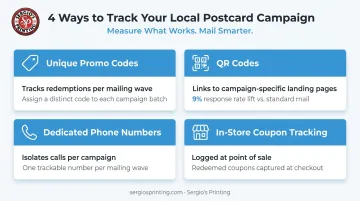
Effective tracking methods for local postcard campaigns:
- Unique promo codes — assign a different code to each mailing wave to track which drop generated redemptions
- QR codes linked to campaign-specific landing pages — Lob cites Keypoint Intelligence research showing digital connectors like QR codes drive a 9% increase in direct mail response rates
- Dedicated phone numbers: a forwarding number used only on that postcard isolates calls from that campaign
- In-store redemption tracking — have staff log each postcard coupon at point of sale
ROI formula:
(Revenue from campaign – Total campaign cost) ÷ Total campaign cost × 100 = ROI%
Even a modest response rate can produce a strong return if average customer lifetime value is high. A salon converting 15 new clients from a 2,000-piece mailing — at $80 average visit value — covers most campaign costs on the first visit alone, before repeat business is counted.
What You Need Before Launching Your Campaign
Skipping preparation is the most common reason local postcard campaigns underperform. Results are only as good as the inputs.
Define Your Budget
A postcard campaign has two cost components: printing and postage.
- EDDM Retail postage: $0.247 per piece
- First-Class postcard (qualifying size): $0.61 per piece
- Printing: varies by size, stock, coating, and quantity — Sergio's Printing offers postcards starting at $29.99 per 100 for standard sizes, with promotional pricing available at higher quantities
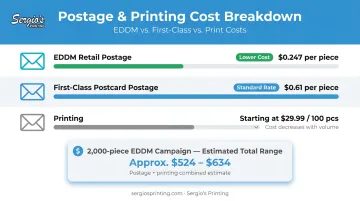
Per-card print cost drops as quantity increases. For budget planning, get a quote at your target quantity before finalizing the mailing zone size. A smaller, better-targeted zone at a higher print quantity can cost less per conversion than a large zone at a low quantity.
A Mailing List or EDDM Route Plan
For EDDM: Use the USPS EDDM tool to select routes with high household density that overlap your service radius. Review actual address counts per route before finalizing quantity.
For targeted lists: Request these data fields at minimum — address, ZIP code, and the demographic filters relevant to your business (homeowner status for home services, presence of pets for groomers, household income for premium services). Lists are available from USPS tools, list brokers, or your own customer database.
A Print-Ready Postcard Design
Every local postcard needs these elements:
- Clear headline with a benefit or offer
- Business name and logo
- Local relevance signal (neighborhood, city, or area reference)
- Offer with a specific expiration date
- Contact information and address (or QR code linking to your site/map)
Files should be 300 DPI and set up with proper bleed margins. Sergio's Printing templates are already sized correctly and bleed-ready, which cuts down on errors and speeds up turnaround.
A Tracking Mechanism Set Up in Advance
QR codes, promo codes, and dedicated phone numbers must be created and tested before postcards go to print. Once cards are printed, nothing can be added or changed.
Set up tracking first. Without it, there's no way to calculate ROI or refine targeting for future mailings.
Key Variables That Affect Local Postcard Campaign Results
Two businesses can mail the same number of postcards to the same neighborhood and see entirely different results based on how they handle these four variables.
Targeting Precision
The tighter the targeting, the more relevant the postcard feels. A restaurant mailing within a 2-mile radius reaches people who can walk or drive there in minutes — the friction of acting on the offer is low. The same mailer sent to a 10-mile radius reaches households for whom the trip is a deliberate decision, not a convenient one.
Use the EDDM mapping tool to select routes where your realistic customer actually lives, not just routes that increase your total reach.
Offer Strength and Urgency
The offer drives action more than any other design element. A postcard with no concrete incentive — "visit us anytime" — generates far fewer responses than one with a specific, expiring discount.
Adding an expiration date forces a decision. Without one, recipients set the card aside and forget it. A deadline (even "valid through end of month") creates a reason to act now rather than eventually.
Postcard Design Clarity
Recipients make a keep-or-toss decision in seconds. A cluttered design with three competing headlines, a dense paragraph of copy, and four different CTAs gets discarded.
What works:
- One dominant visual that stops the eye
- A clear benefit headline (not a clever one)
- A single CTA with no competing asks
Contrast and hierarchy matter — especially on smaller 4×6 formats where space is limited.
Mailing Frequency
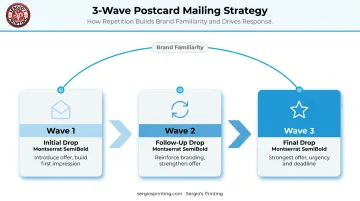
A single mailing rarely builds enough familiarity with a cold audience for them to take action. Planning 2–3 mailing waves with consistent branding and a progressively stronger offer builds recognition over time. Each wave does more work than the last — by the third mailing, recipients recognize your brand and have seen your offer enough to act on it.
Common Mistakes When Targeting Local Customers With Postcards
Most postcard campaigns that fall flat share the same avoidable errors. Watch for these four:
Mailing too broadly to cut per-piece cost. Expanding beyond your realistic service area inflates volume while lowering relevance — fewer recipients will actually visit, and your cost-per-conversion rises.
Cutting corners on design or print quality. A cluttered or cheaply printed postcard signals low credibility. For many local customers, it's their first impression of your business.
Sending one mailing and expecting sustained results. A single drop rarely converts a cold audience. Plan for at least two to three waves with consistent branding and escalating offers.
Not setting up tracking before printing. Once cards are printed, promo codes and QR codes are locked in — or missing entirely. Without them, there's no way to measure what the campaign generated or improve the next one.
Frequently Asked Questions
How do I target local customers with postcards?
Identify your service radius first — typically 1–5 miles depending on business type — then use EDDM to cover every address on selected carrier routes, or a filtered mailing list if you need to match a specific demographic. The free USPS EDDM tool shows exact household counts by route before you commit to quantities.
Does postcard marketing still work?
Yes. The USPS Household Diary Study reports that 50% of households read advertising mail and 16% scan it — attention levels most digital channels don't match. Success depends on offer strength, precise targeting, and multiple mailings rather than a single blast.
What is EDDM and is it right for my local business?
EDDM (Every Door Direct Mail) is a USPS program that mails to every address on a selected carrier route without requiring a purchased mailing list, at a lower postage rate of $0.247 per piece. It works best for businesses with broad local appeal — restaurants, gyms, retail. If your target customer needs to match a specific demographic, a filtered mailing list is the better fit.
How much does a local postcard campaign cost?
Budget for printing plus postage: EDDM runs $0.247 per piece, First-Class postcard postage is $0.61 per piece for qualifying sizes. Print costs drop with volume — Sergio's Printing starts at $29.99 per 100 postcards — making a 2,000–3,000 household campaign achievable on a modest budget with EDDM rates.
What postcard size works best for local direct mail?
Larger formats like 6×9 or 6×11 stand out more in a mailbox and typically generate stronger response. Smaller 4×6 formats cost less per piece and work well for high-volume campaigns where budget limits larger formats. The right choice depends on how much design space you need to communicate the offer and what your print budget allows.
How do I measure the ROI of a postcard campaign?
Track redemptions through unique promo codes, QR codes, or a dedicated phone number, then apply: (Revenue – Total Campaign Cost) ÷ Total Campaign Cost × 100. Even a response rate of 1–2% can produce a positive return if average customer value is high — which is why setting up tracking before you send to print is essential.