The catch? Postcard mailer costs vary dramatically based on size, quantity, postage class, and whether you're handling design and mailing yourself or using a full-service provider. Many businesses get surprised mid-campaign because they budgeted only for printing and overlooked postage — often the single largest line item.
This guide breaks down every cost layer — printing, postage, mailing lists, design, and mail prep — so you can build an accurate budget before placing your first order.
Key Takeaways
- All-in postcard mailer costs typically run $0.30–$1.75+ per piece, depending on format and services included
- The four main cost drivers are printing, postage, mailing list, and design
- Larger print quantities lower the per-piece cost — sometimes by 50% or more
- EDDM (~$0.247/piece) is the cheapest postage option; First-Class single-piece ($0.61/piece) is most expensive
- Budgeting only for printing without factoring in postage is the most common reason direct mail campaigns go over budget
How Much Do Postcard Mailers Cost?
There's no single fixed price. A local restaurant running an EDDM neighborhood drop will pay far less per piece than a B2B company mailing First-Class to a purchased prospect list. Comparing vendors on print cost alone misses the point — postage alone can equal or exceed the print cost.
What goes wrong when costs are misunderstood:
- Underbudgeting for postage (the biggest line item most people underestimate)
- Choosing an oversized format and unknowingly triggering a higher postage tier
- Forgetting to budget for list rental or design fees
Typical Cost Ranges
| Campaign Type | All-In Per-Piece Range | What's Typically Included |
|---|---|---|
| Entry-level / EDDM | $0.30–$0.55 | Printing, EDDM postage, basic mail prep |
| Mid-range / Marketing Mail | $0.55–$0.95 | Printing, presort postage, list, addressing |
| High-end / First-Class | $1.00–$1.75+ | Printing, First-Class postage, purchased list, design |
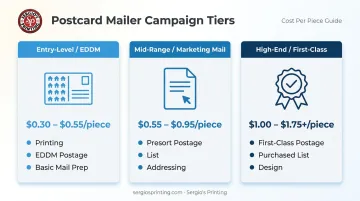
These ranges assume printing on coated stock. They typically exclude professional design fees, purchased mailing lists, tracking, and variable data personalization unless specified. These ranges assume printing on coated stock. They typically exclude professional design fees, purchased mailing lists, tracking, and variable data personalization unless specified.
Here's what each tier actually covers — and who it's right for.
Entry-Level / EDDM Campaigns
This tier covers standard-size or EDDM-eligible postcard printing plus USPS EDDM Retail postage at $0.247 per piece, with no list purchase needed.
Restaurants, home services, and retail businesses use EDDM for broad neighborhood reach at the lowest possible per-piece cost. It's also the natural starting point for first-time mailers testing a local market.
Mid-Range / Marketing Mail Presort Campaigns
A typical mid-range campaign (1,000–5,000 pieces) runs $0.55–$0.95 all-in and includes:
- Printing on 4×6 to 6×9 coated stock
- A CASS-validated address list
- Marketing Mail Presort postage (~$0.372–$0.433 per piece for letter-size)
- Inkjet addressing and USPS mail prep
This tier suits small-to-medium businesses targeting a specific demographic or geography — a solid balance of cost savings and audience precision.
High-End / First-Class Addressed Campaigns
This tier covers larger postcard formats (6×9 or 6×11), First-Class postage (~$0.42–$0.468 per piece at presort rates), a purchased consumer or B2B list, professional design, and variable data personalization.
It's the right choice for high-value offers, time-sensitive promotions, or B2B prospecting where deliverability, speed, and address forwarding justify the higher cost.
Key Factors That Affect Postcard Mailer Cost
Understanding each cost lever tells you where you can save money and where cutting corners will hurt results.
Postcard Size and Format
USPS classifies mailpieces as either postcard/card rate or letter rate based on dimensions:
- Postcard rate: Pieces up to 6" long × 4.25" high — standard 4×6 postcards qualify at the lower rate
- Letter rate: Pieces exceeding those dimensions — 5×7, 6×9, and 6×11 all mail at the higher letter rate
The postage difference matters. A 4×6 at First-Class retail costs $0.61; a 6×9 mailing as a letter costs $0.78 at the same retail rate. At scale, that gap adds up fast.
Larger formats command more attention in the mailbox, but size alone doesn't guarantee better response. Match size to budget and message complexity — a simple offer fits a 4×6; a product showcase or event invite benefits from 6×11.
Print Quantity
Press setup is a fixed cost. The more pieces you print, the less that setup cost adds per unit. Published pricing from PrintDirectForLess illustrates this:
| Quantity | Per-Piece Print Cost |
|---|---|
| 500 | ~$0.168 |
| 1,000 | ~$0.098 |
| 2,500 | ~$0.058 |
| 5,000 | ~$0.044 |
| 10,000 | ~$0.037 |
Quantity also unlocks postage discounts. The Marketing Mail Presort minimum is 200 pieces; First-Class Presort requires 500 pieces and can cut postage by roughly 24–31% versus the $0.61 retail rate.
Paper Stock and Finishing
Standard 14-point coated cover is professional and functional — it's what most postcard campaigns use. Upgrading to 16-point with gloss UV or soft-touch laminate increases print cost but improves the tactile experience and perceived quality.
For high-ticket offers or brand-forward campaigns, premium finishing can lift response by making your piece feel worth holding. For high-frequency awareness mailings, standard stock is the right call.
Postage Class
| Class | Current Rate | Minimum | Notes |
|---|---|---|---|
| First-Class single-piece | $0.61 (postcard) | None | Forwards undeliverable mail |
| First-Class Presort | $0.420–$0.468 | 500 pieces | Faster delivery, address forwarding |
| Marketing Mail Presort | $0.372–$0.433 | 200 pieces | Slower (2–9 days), no forwarding |
| EDDM Retail | $0.247 | 200 pieces | Routes-only, no individual addressing |
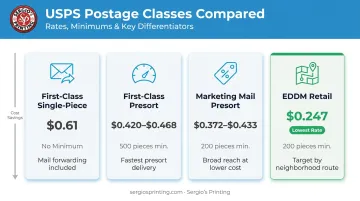
Rates effective April 26, 2026 per USPS Notice 123. USPS has proposed raising the First-Class postcard rate to $0.65 effective July 12, 2026. Verify current rates before budgeting.
Design Costs
Freelance or agency design runs $100–$300+ per hour. Many full-service mail providers bundle flat design fees of $99–$299 into campaign quotes.
For businesses that want to skip that expense, Sergio's Printing offers a built-in design studio with industry-specific templates — no separate design charge. Options include:
- Customize a pre-built template (16 categories: Food & Beverage, Real Estate, Beauty & Spa, Events, and more)
- Upload your own finished artwork
- Build from scratch using the online design tool
That removes one of the more variable line items from a campaign budget.
Complete Cost Breakdown of a Postcard Mailer Campaign
Businesses that budget only for printing regularly get caught off guard when the full invoice arrives. Every cost component is listed below:
| Line Item | Typical Range | Notes |
|---|---|---|
| Printing | $0.05–$0.35 per piece | Depends on size, stock, quantity, and color; most vendors quote this first |
| Postage | $0.247–$0.61+ per piece | Largest single cost for most campaigns; paid to USPS upfront |
| Mailing List | $0–$0.15 per record | Consumer lists ~$0.025–$0.125/record; B2B lists higher; house lists are free |
| NCOA Processing | ~$1.50/1,000 records | Cleans existing lists to avoid wasted postage on outdated addresses |
| Design | $0–$300+/hour | $0 with template tools; flat-rate bundles ($99–$299) from full-service providers |
| Lettershop / Mail Prep | $0.03–$0.15 per piece | Inkjet addressing, sorting, traying, USPS drop-off |
Three line items deserve a closer look:
- EDDM eliminates list cost entirely — you're targeting routes, not named individuals
- House lists are free to use, but still need NCOA processing (~$1.50 per 1,000 records via providers like Melissa) to remove outdated addresses before you mail
- Consumer list pricing varies widely: Melissa lists consumer records at $25 per 1,000; LeadsPlease prices start around $124.95 per 1,000 — compare providers before purchasing
Budget vs. Premium Postcard Mailers
Both approaches can deliver results. The right choice depends on your offer, audience, and how quality perception affects conversion.
| Dimension | Budget | Premium |
|---|---|---|
| Format | 4×6, standard stock, Marketing Mail | 6×9 or 6×11, heavy stock, UV finish, First-Class |
| Mailbox Impact | Functional, cost-effective | Stands out, signals brand credibility |
| Durability | 14-point coated cover | 16-point with soft-touch or gloss UV |
| Best For | High-frequency awareness campaigns | High-ticket offers, B2B prospecting, customer retention |
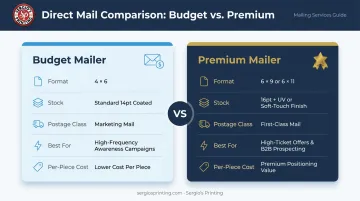
Cheaper per piece is not always lower cost per response. A $0.40 postcard that converts at 1% generates leads at $40 each. A $0.90 premium piece that converts at 3% costs $30 per lead — a better outcome despite the higher unit price. Run your own conversion assumptions before defaulting to the cheapest option.
How to Estimate the Right Budget for Your Campaign
Start with your average customer lifetime value, not your printing budget. What's a new customer actually worth? That number tells you how much you can afford to spend per acquisition — and working backward from there produces a rational campaign budget.
Key factors to consider:
- Your house customer list costs the least and converts highest. Rented prospect lists extend reach at added cost. EDDM covers whole neighborhoods with no list expense.
- A single mailing works for one-time events. For new customer acquisition, a 3-touch sequence reinforces recall and improves response rates — reusing creative across drops also cuts per-unit design cost.
- A 4×6 handles simple offers and coupons cleanly. A 6×11 fits multiple products, event details, or layered promotions. Sergio's Printing's template library spans retail, food and beverage, real estate, events, and several other categories — browsing it before locking in a size helps you see what each format can actually hold.
Even a well-planned budget can go sideways. Watch for these common mistakes:
Mistakes that inflate costs or undermine results:
- Budgeting only for printing without factoring postage
- Skipping NCOA cleaning and paying to mail returned pieces
- Over-specifying premium finishes for a low-value or high-frequency offer
- Choosing the cheapest option without verifying print quality standards and deliverability compliance
Frequently Asked Questions
What is the current postcard mailing rate?
First-Class single-piece postcard postage is $0.61; Marketing Mail Presort runs $0.372–$0.433 per piece (200-piece minimum); EDDM Retail is $0.247 per piece. A rate increase is proposed for July 12, 2026 — confirm current rates at USPS Postal Explorer before ordering.
Is it cheaper to mail a postcard than a letter?
Standard-size postcards (up to 6" × 4.25") qualify for the USPS postcard rate of $0.61, which is lower than the $0.78 retail letter rate. Oversized postcards (5×7, 6×9, 6×11) exceed those dimensions and mail at letter rates.
How much does it cost to print and mail 500 postcards?
Expect $150–$280 all-in for 500 standard postcards — roughly $75–$115 for printing plus $85–$130 in First-Class Presort postage (~$0.42–$0.47/piece). Larger formats and full-service mail prep push that higher.
What postcard size is the cheapest to mail?
Standard sizes — 4×6 and 4.25×6 — qualify for the lower USPS postcard rate. Anything taller than 4.25" or longer than 6" (such as 5×7, 6×9, or 6×11) mails as a letter at a higher rate. EDDM-eligible sizes have their own separate rate ($0.247), which is often the lowest available postage option.
Does printing more postcards lower the cost per piece?
Yes, significantly. Per-piece print costs drop as volume rises because press setup is a fixed cost spread across more units. At 500 pieces, expect around $0.17/piece; at 5,000, that can fall to $0.04/piece. Higher quantities also unlock bulk postage discount tiers, compounding the savings.
How much does postcard design cost?
Design ranges from $0 — Sergio's Printing's built-in design studio offers ready-to-use templates at no extra charge — to $100–$300+ per hour for freelance or agency work. Many full-service mail providers offer flat-rate packages in the $99–$299 range. For most small businesses, template-based tools eliminate this cost entirely.